
The simplest way to track business expenses is to run every business purchase through one separate account, save a copy of each receipt the day you get it, and record it in one spreadsheet or ledger once a week. That gives you the totals you need for taxes and shows you where your money goes. The whole habit takes about 15 minutes a week.
This guide walks you through setting it up from scratch, even if your receipts are currently in a shoebox, a glovebox and three email inboxes.
General information only, not tax advice. Rules change, so check irs.gov or a tax professional for your situation.
Why tracking expenses matters
Every dollar of legitimate business expense you can prove lowers your taxable profit. If you are self-employed, profit is taxed twice: once for income tax and once for self-employment tax, which the IRS sets at 15.3% (12.4% Social Security plus 2.9% Medicare).
A quick example. Say you forgot to record $1,500 of supplies. Your profit is overstated by $1,500, so your self-employment tax alone is too high by about $1,500 x 0.9235 x 0.153 = $211.94, before income tax. Small lost receipts add up.
The IRS also says good records help you watch how your business is doing, prepare financial statements and back up what you put on your return. You can use any system that clearly shows your income and expenses.
Step 1: Separate business and personal money
Open a separate checking account (and, if you use one, a card) just for the business. It is the single biggest time saver:
- Your bank statement becomes a first draft of your expense list.
- You never have to sort a grocery run from a supply run.
- If the IRS ever asks, your business spending is easy to show.
If you use one card for both today, pick a start date (the first of next month works) and move all business spending to the new account from then on.
Step 2: Choose a short list of categories
Use the same categories all year. Too many and you will stop using them. A good starting list for most service businesses:
| Category | Examples |
|---|---|
| Supplies | Cleaning products, printer ink, packaging |
| Equipment and tools | Mower, camera, pressure washer, laptop |
| Vehicle and fuel | Fuel, repairs, parking, tolls (or use mileage) |
| Advertising | Flyers, business cards, online ads, website |
| Software and subscriptions | Booking app, cloud storage, design tools |
| Insurance | General liability, business auto, bonding |
| Licenses and fees | Business license, permits, bank fees |
| Contract labor | Helpers paid as contractors |
| Phone and internet | The business share of your bill |
| Training | Courses, certification fees |
| Other | Anything that does not fit, with a note |
If you are starting a new business, the trade guides list typical costs, for example how to start a cleaning business or how to start a lawn care business.
Step 3: Capture every receipt the same day
Receipts get lost because the habit is "later." Make it "now":
- Paper receipt: take a photo before you leave the parking lot and save it to one folder named by year and month, for example
2027-03. - Email receipt: forward it to one folder or label called "Receipts 2027."
- No receipt (cash, a parking meter): write a quick note with date, amount, who you paid and why.
The IRS says your purchases and sales create supporting documents, and those documents hold the details you record in your books. Keep them.
Step 4: Record expenses once a week
Pick a fixed time, such as Friday afternoon. Open your bank account and your receipts folder side by side and add each new expense as one row:
| Date | Paid to | Category | Amount | Note |
|---|---|---|---|---|
| 03/02 | Supply store | Supplies | $86.40 | Microfiber, spray bottles |
| 03/04 | Gas station | Vehicle and fuel | $52.10 | Route to clients |
| 03/09 | Print shop | Advertising | $45.00 | 500 door hangers |
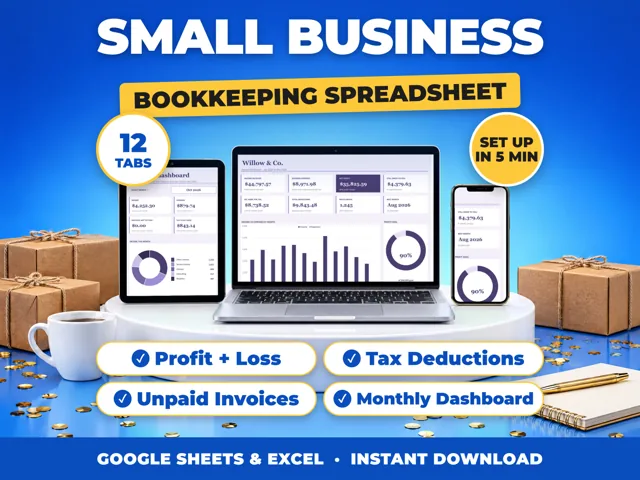
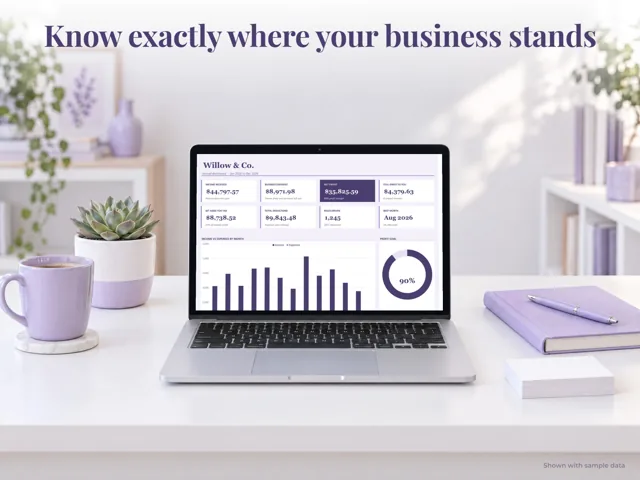
That is all a good expense log needs. If you prefer something ready to use, a file like the small business bookkeeping spreadsheet already has Income, Expenses and Mileage tabs, plus a Monthly Summary, Quarterly view and Tax Summary that total everything for you. For a side job alongside a regular paycheck, the side hustle income and expense tracker is a lighter option.
Step 5: Log business miles
If you drive for work, miles are often one of your biggest deductions. You generally choose either the standard mileage rate or your actual vehicle costs for the business share of use.
The IRS business standard mileage rate changed during 2026:
- January 1 to June 30, 2026: 72.5 cents per mile
- July 1 to December 31, 2026: 76 cents per mile
The 2027 rate had not been announced when this guide was updated, so check the IRS standard mileage rates page before you use it.
Worked example: you drove 4,200 business miles in 2026, with 2,000 of them before July and 2,200 after.
- 2,000 x $0.725 = $1,450.00
- 2,200 x $0.76 = $1,672.00
- Total mileage deduction: $3,122.00
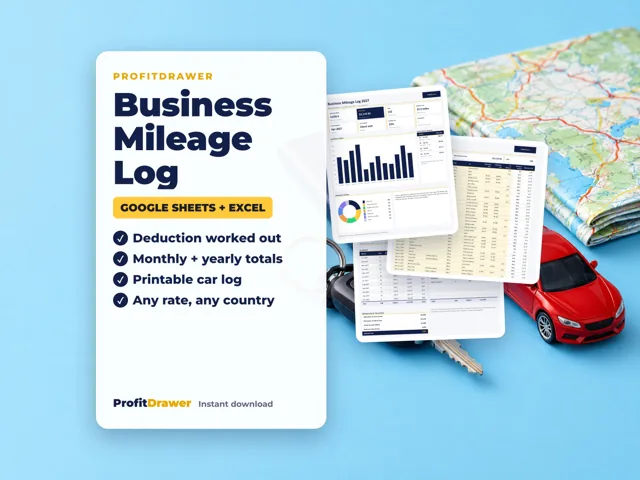
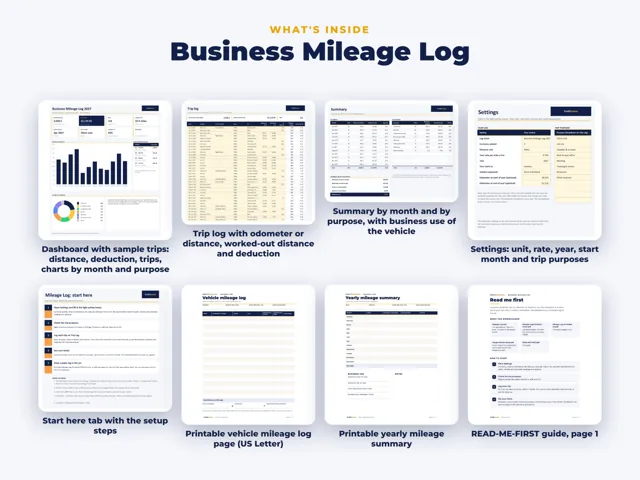
That only works if you can prove the miles. Write down the date, where you went, the business reason and the miles for each trip, at the time you drive. A business mileage log with a printable sheet for the car makes this a 10 second habit.
Step 6: Review your numbers every month
At the end of each month, spend five more minutes:
- Total income minus total expenses gives your profit for the month.
- Look at your biggest categories. Is fuel creeping up? Are subscriptions you forgot about still billing?
- Set aside tax money. Move a percentage of profit into a separate savings account. The free self-employed tax calculator helps you pick a set-aside amount.
If you pay estimated tax, your quarterly totals are ready when a payment is due. The 2027 payment dates are in our guide to small business tax deadlines 2027.
How long to keep your records
The IRS says to keep records as long as you need them to prove income or deductions on a return. In general:
| Situation | Keep records for |
|---|---|
| Most cases | 3 years from filing |
| Employment tax records | At least 4 years after the tax is due or paid |
| You left out more than 25% of gross income | 6 years |
| A bad debt or worthless securities loss | 7 years |
| You did not file, or filed a fraudulent return | Indefinitely |
Keep records about property you own (like a vehicle or equipment) until the time limit runs out for the year you sell or dispose of it.
Common mistakes to avoid
- Mixing personal and business purchases on one card with no notes.
- Recording expenses only in April. You will forget half of them.
- Guessing at mileage after the fact instead of logging trips.
- Throwing away receipts once the bank shows the charge. A bank line shows the amount, not what you bought.
- Too many categories. Keep it to about ten.
A 30-day plan to get organized
- Week 1: open a business account and choose your categories.
- Week 2: gather every receipt from this year into one folder and start your expense log.
- Week 3: start a mileage log and record each trip as you drive.
- Week 4: do your first monthly review and set your tax set-aside percentage.
After that, it is 15 minutes a week. Your future self in tax season will thank you.
Tools for this



Questions people ask
What is the easiest way to keep track of business expenses?
Use one business bank account or card for every business purchase, keep a digital copy of each receipt, and update a simple spreadsheet once a week. That covers most small businesses. The spreadsheet only needs a date, who you paid, what it was for, a category and the amount.
How do I keep track of business expenses in a spreadsheet?
Give each expense one row with date, payee, category, amount and a note, and use the same short list of categories all year. Then total by month and by category. For example, if fuel rows add up to $310 in March and $290 in April, you can see the trend and you already have the totals for tax time.
What business expenses are tax deductible?
In general, ordinary and necessary costs of running your business, such as supplies, tools, advertising, software, insurance and business use of a vehicle. Personal costs are not deductible, and some items have special rules. Check irs.gov or ask a tax professional about what applies to you.
Can I write off my car payment as a business expense?
Usually not the payment itself. You generally choose between the standard mileage rate and actual vehicle costs (such as fuel, repairs, insurance and depreciation) for the business share of use. For the first half of 2026 the IRS business rate was 72.5 cents a mile, so 3,000 business miles in that period is 3,000 x $0.725 = $2,175.
How long should I keep receipts for business expenses?
The IRS general rule is 3 years from when you file the return, with longer periods in some cases, such as 4 years for employment tax records and 6 years if you left out more than 25% of your income. Many owners keep 7 years to be safe.
Sources
General information, not tax, legal or financial advice. Check the rules for your state and your situation.