
To start a lawn care business, decide on your core services (mowing, edging, trimming and blowing are the usual start), check your city, county and state license rules, get basic equipment and insurance, price each lawn by size and time, and fill a route of weekly clients close to home. Many people start with a home mower and a few neighbors, then reinvest in commercial gear. The businesses that last price every lawn on real numbers and keep track of every dollar.
Here is each step, with an example budget, a worked price for one lawn and a 30-day plan. If you want to offer installs, hardscape or planting too, read how to start a landscaping business.
1. Choose your lawn care services
Most lawn care businesses start with a simple package:
- Mow, trim, edge and blow: the weekly or biweekly core service.
- Spring and fall cleanups: leaves, sticks, bed edging. Good extra income at the start and end of the season.
- Aeration and overseeding: seasonal add-ons that can be done with rented machines.
- Hedge and shrub trimming: quick add-ons on existing routes.
- Fertilizer and weed control: popular, but in many states you need certification before applying products for pay.
Offer weekly service as the default. Biweekly lawns get longer between visits, take more time and are harder to price fairly.
2. Check local requirements
Requirements vary by location, so check with your city, county and state before your first paid mow. The SBA explains that most small businesses need a mix of state and local licenses, and that local governments often require their own.
Your checklist:
- Pick a structure. Sole proprietor is simplest; an LLC adds a state fee but separates liability.
- Register your name as a DBA if you use a business name.
- Get a general business license if your city or county requires one.
- Check chemical rules. The EPA says states, territories and tribes certify pesticide applicators, and many states require certification for all commercial applicators. Ask your state agriculture department before you offer weed control.
- Get an EIN from the IRS if you hire employees. It is free.
- Buy insurance. General liability covers things like a rock thrown through a window. Your auto policy may not cover business use, so ask your agent.
3. Work out your startup costs
Example budget, your costs will differ:
| Item | Low | High |
|---|---|---|
| Mower (good residential, or used or new commercial walk-behind or zero-turn) | $400 | $8,000 |
| String trimmer | $150 | $450 |
| Backpack or handheld blower | $150 | $500 |
| Edger | $0 | $400 |
| Small trailer or ramps (if no trailer, use a pickup bed) | $100 | $2,500 |
| Gas cans, oil, spare blades, line, safety gear | $100 | $300 |
| Business registration and license | $50 | $300 |
| Insurance (first months) | $150 | $800 |
| Door hangers, yard signs, simple website | $100 | $650 |
| Total | $1,200 | $13,900 |
Put your own list into the free startup cost calculator to see your total and how many lawns it takes to pay it back.
4. Price each lawn
Most lawn care businesses quote a flat price per cut based on lawn size, obstacles and drive time. To get there, know your cost per hour on site.
Worked pricing example for one lawn (example numbers only):
- Lawn: about a quarter acre, with a few beds and a fence line
- Time on site: 40 minutes (0.67 hours)
- Your target pay: $35 an hour, so 0.67 x $35 = $23.45
- Fuel, line and wear on equipment: about $4 a cut
- Drive: 3 miles from the last stop. Using $0.70 a mile as a rough running cost, 3 x $0.70 = $2.10
- Share of insurance, phone and marketing: $4
- Cost before profit: $23.45 + $4 + $2.10 + $4 = $33.55
- Add 25% for profit, taxes and rain days: $33.55 x 1.25 = $41.94
- Price: $45 per weekly cut
The same lawn on a biweekly schedule takes longer, so price it higher (for example $55). The free price per job calculator runs this math for any lawn. Check what other local mowing services charge so your price is in range.
5. Find your first customers
- Your street first. Knock on doors or leave door hangers on homes with overgrown or unkept lawns, close to your own address.
- Neighbors of each new client. After every cut, leave hangers on the houses on either side and across the street.
- Local community groups and neighborhood apps with before and after photos.
- A free business listing on map and search results.
- Rental owners and property managers who need steady, reliable service.
- An early season offer, such as a discounted spring cleanup for clients who sign up for weekly mowing.
Dense routes are where lawn care profit lives. Ten lawns on two streets beat ten lawns across town.
6. Track your money and plan for taxes
Track every payment, what customers still owe you and every expense: fuel, blades, repairs, insurance, marketing. A separate business bank account keeps it clean.
- Mileage: log trips between lawns and to the parts store. The IRS business standard mileage rate for 2026 was 72.5 cents a mile from January to June and 76 cents from July to December. Check the 2027 rate on irs.gov.
- Taxes: if you work for yourself, you owe self-employment tax of 15.3% on net earnings plus income tax. The IRS says sole proprietors generally make estimated payments if they expect to owe $1,000 or more for the year. See small business tax deadlines for 2027, and estimate your set-aside with the free self-employed tax calculator. This is general information, not tax advice.
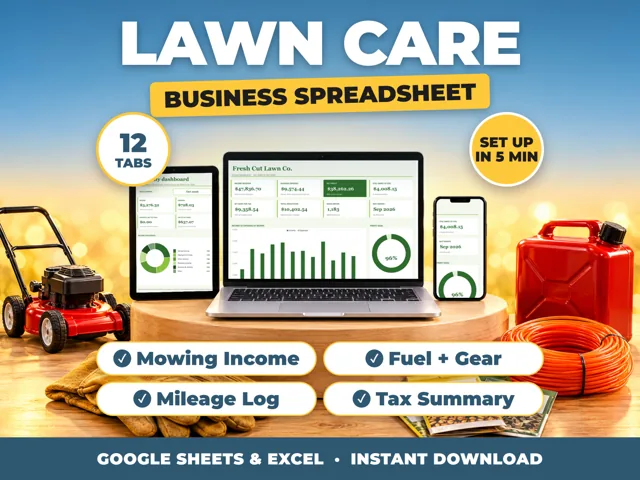
The lawn care business spreadsheet for Excel and Google Sheets has START HERE, Settings, dashboards, Income, Expenses, Mileage, Unpaid Invoices, Top Clients, a Monthly Summary, Quarterly totals and a Tax Summary, so you can see profit by month and what to save for taxes. For a simple weekly routine, read how to track business expenses.
7. A simple 30-day launch plan
Days 1 to 7: decide - Choose your services and a small service area. - Check license and chemical rules with your city, county and state. - Get insurance quotes and pick a name.
Days 8 to 14: set up - Register, open a bank account and buy insurance. - Service your mower, sharpen blades and buy spare line and blades. - Time yourself on your own lawn and a friend's to set prices.
Days 15 to 21: fill the route - Hand out door hangers on 200 to 300 homes near you. - Post in local groups and set up a business listing. - Book your first 5 to 10 weekly lawns.
Days 22 to 30: mow and review - Mow on a fixed day for each street. - Write down actual time per lawn and adjust any underpriced ones. - Ask happy clients for a review and a referral. - Check income, expenses and profit for the month.
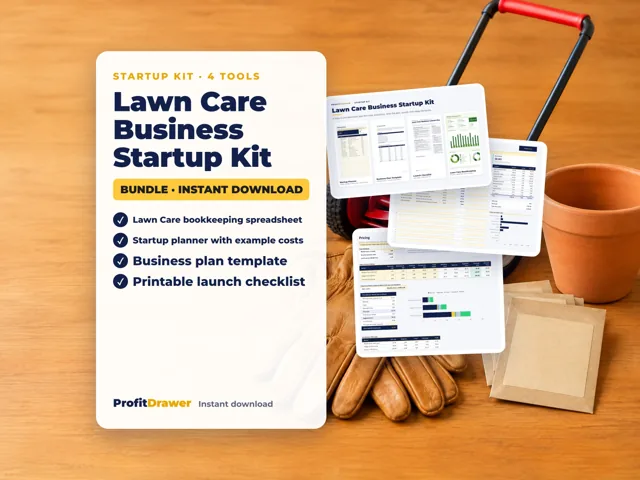
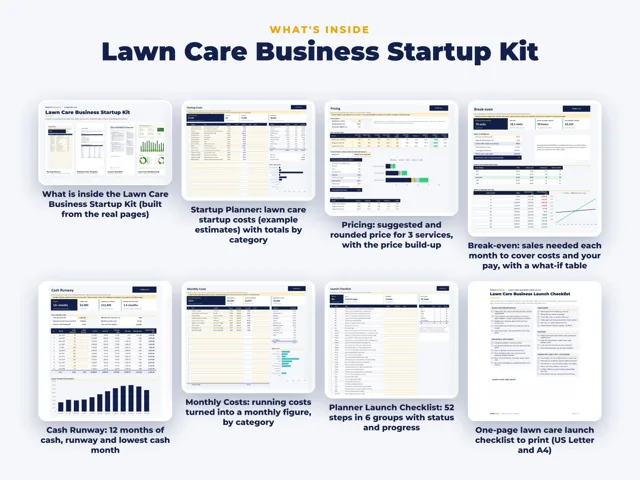
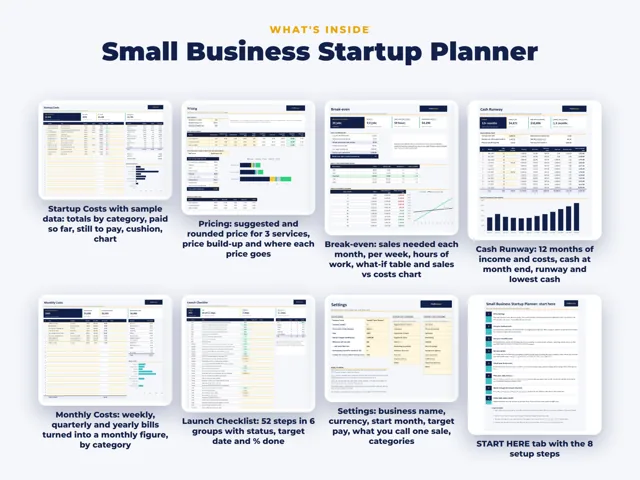
The lawn care business startup kit bundles the lawn care spreadsheet with a Startup Planner workbook (startup costs, pricing, break-even, cash runway), a business plan template and a launch checklist. The small business startup planner is also sold on its own.
Common mistakes to avoid
- Quoting lawns without seeing them. Hills, fences and beds change the time a lot.
- Taking clients too far apart. Drive time eats your hourly pay.
- Skipping blade sharpening and maintenance. Dull blades give a poor cut and wear out engines.
- Applying weed killer without certification where your state requires it.
- Spending all summer income. Save for winter and for next season's repairs.
A lawn care business can grow from one mower to a full route in a single season. Keep the route tight, price each lawn properly and know your numbers every month.
Tools for this





Questions people ask
How much does it cost to start a lawn care business?
It depends on the mower you start with and whether you already have a vehicle that can haul it. A residential mower, trimmer and blower in a pickup bed can get you started for under $1,500, while a commercial mower and trailer push the total much higher. Our example budget below runs from about $1,200 to $13,900, but your costs will differ.
How do I start a lawn care business with no money?
Start with what you already own, such as a home mower and trimmer, and take a few jobs on your street to fund better gear. Keep a tight service area, ask for payment on completion, and put a share of every job back into equipment. Buy used commercial equipment once you have enough steady clients to justify it.
Do I need an LLC for a lawn care business?
No, an LLC is not required in most places. Many mowing businesses start as sole proprietors. An LLC can separate business and personal liability, but you still need insurance, and the state filing fee and yearly reports vary, so compare the cost and ask a local professional if you are unsure.
How much does a lawn care business license cost?
It depends on your city, county and state. Some places charge a small yearly fee for a general business license, some charge nothing, and fertilizer or weed control work may need a separate state certification. Call your city or county clerk and your state agriculture department for the exact fees.
How much does a lawn care business make a year?
It depends on how many lawns you mow, your price and your season length. For example, 40 weekly lawns at $45 for a 30-week season is $54,000 in revenue (40 x 45 x 30). Fuel, repairs, insurance, mileage and taxes come out of that, so track costs to see your real profit.
Sources
- Launch your business: Apply for licenses and permits (U.S. Small Business Administration)
- Launch your business: Register your business (U.S. Small Business Administration)
- How to Get Certified as a Pesticide Applicator (US EPA)
- Get an employer identification number (IRS)
- Estimated taxes (IRS)
- Standard mileage rates (IRS)
General information, not tax, legal or financial advice. Check the rules for your state and your situation.