
To start a cleaning business, choose the type of cleaning you will offer, register your business and get any local license, buy a basic supply kit and insurance, set prices that cover your time and costs, and line up your first few clients from people you already know. Many solo cleaners start for well under $1,000 because they use their own car and simple supplies. The key to staying in business is pricing every job properly and tracking your money from the first day.
This guide walks you through each step in plain language, with an example budget, a worked pricing example and a 30-day launch plan.
1. Choose the cleaning services you will offer
Start narrow. It is easier to get good, fast and known for one kind of job than to offer everything at once. Common options:
- Residential (house) cleaning: regular weekly or biweekly visits, deep cleans, and move in or move out cleans. Easy to start, and recurring clients give you steady income.
- Move out cleaning: one-time jobs for renters, landlords and real estate agents. Higher price per job, less repeat work.
- Commercial cleaning: small offices, studios, clinics and shops, often in the evening. Larger contracts, but clients may ask for proof of insurance, a written agreement and sometimes a bond.
- Specialty cleaning: windows, carpets, post-construction or short-term rental turnovers. These usually need extra equipment or training.
Pick one main service and one add-on (for example, recurring house cleaning plus inside-oven and inside-fridge add-ons). You can expand once you have steady clients.
2. Check local requirements and register
Every location has its own rules, so check with your city, county and state before you take paid work. The SBA explains that most businesses need some mix of state and local licenses and permits, and that requirements depend on your activity and location.
A simple checklist:
- Pick a business structure. Many cleaners start as a sole proprietor. Some form an LLC to separate business and personal liability. A state filing fee applies to LLCs.
- Register your business name. If you use a name other than your own legal name, most states require you to register it as a DBA ("doing business as").
- Get a general business license from your city or county if they require one.
- Get an EIN from the IRS if you will hire employees or form a partnership or corporation. It is free on irs.gov; never pay a website for one.
- Ask about sales tax. A few states tax some cleaning services. Check with your state revenue department.
- Get insurance. General liability insurance is the usual starting point, since you work in other people's homes. If you hire, workers' compensation rules apply in most states. Commercial clients may ask about a janitorial bond.
3. Work out your startup costs
Write down every cost before you spend anything. The SBA suggests listing one-time costs (equipment, licenses) separately from monthly costs (insurance, phone, gas).
Example budget, your costs will differ:
| Item | Low | High |
|---|---|---|
| Cleaning supplies and chemicals | $150 | $400 |
| Vacuum, mop system, microfiber cloths, caddy | $150 | $800 |
| Business registration and local license | $50 | $500 |
| General liability insurance (first months) | $100 | $600 |
| Simple website or booking page, business cards | $0 | $400 |
| Uniform or branded shirts | $0 | $150 |
| Marketing (flyers, local ads) | $50 | $500 |
| Phone and software for the first months | $50 | $150 |
| Total | $550 | $3,500 |
Commercial cleaning or carpet cleaning will cost more because of larger equipment. Plug your own numbers into the free startup cost calculator to see your total and how long your savings will last.
4. Set your prices
Cleaners usually price in one of three ways: by the hour, by the job (flat rate based on home size), or by square foot for commercial work. Flat rates are popular with homeowners because they know the price up front.
To set a flat rate, start from your costs and the pay you want:
Worked pricing example (example numbers only):
- Time for a 3-bedroom, 2-bath recurring clean: 3 hours
- Your target pay: $30 an hour, so 3 x $30 = $90
- Supplies used per visit: $6
- Driving: 12 miles round trip. Using $0.70 a mile as a rough running cost, 12 x $0.70 = $8.40
- Share of insurance, phone and marketing: about $10 per visit
- Cost before profit: $90 + $6 + $8.40 + $10 = $114.40
- Add a 20% markup for taxes and slow weeks: $114.40 x 1.20 = $137.28
- Round to a price of $140 per visit
A first deep clean of the same home takes longer, so price it separately (for example, 5 hours instead of 3). The free price per job calculator does this arithmetic for you.
Before you settle on a number, look at what local cleaners advertise so your price is in a sensible range. Do not compete only on being the cheapest; reliable, on-time cleaners keep clients longer.
5. Get your first customers
Your first five clients will almost always come from people who already know you or live near you.
- Tell everyone you know. Friends, family, coworkers and neighbors. Ask each one for a referral.
- Local community groups and neighborhood apps. Post a short intro with a photo and your service area.
- Flyers and door hangers in neighborhoods close to home, so travel time stays low.
- A free business profile on map and search listings, with photos and your service area.
- Realtors and property managers for move out cleans.
- Referral reward: for example, $20 off the next clean for each new client who books.
Ask happy clients for a short review after the second or third visit, when they already trust you.
6. Track your money and plan for taxes
From the first job, keep business money separate from personal money. A separate checking account makes tax time far easier.
Track these every week:
- Income from each client, and which invoices are still unpaid
- Expenses such as supplies, equipment, insurance, phone and advertising
- Mileage for driving between jobs and to buy supplies. The IRS business standard mileage rate for 2026 was 72.5 cents a mile from January to June and 76 cents a mile from July to December. Check the 2027 rate on irs.gov before you file.
As a self-employed cleaner you pay self-employment tax of 15.3% on net earnings (Social Security plus Medicare), on top of income tax, and you may need to make quarterly estimated tax payments. See our guide to small business tax deadlines for 2027 and the free self-employed tax calculator to estimate how much to set aside. This is general information, not tax advice.
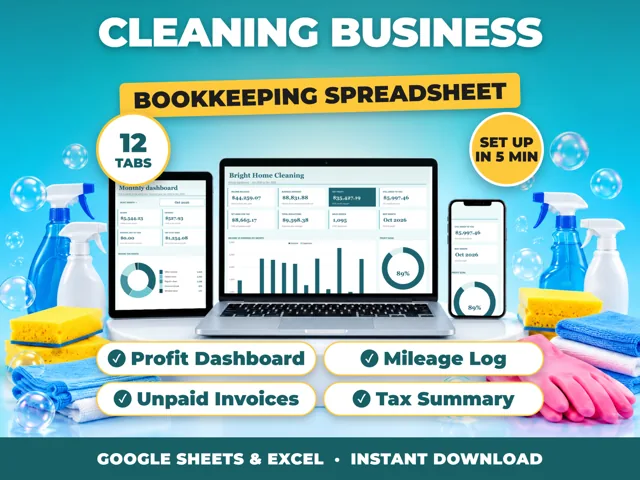
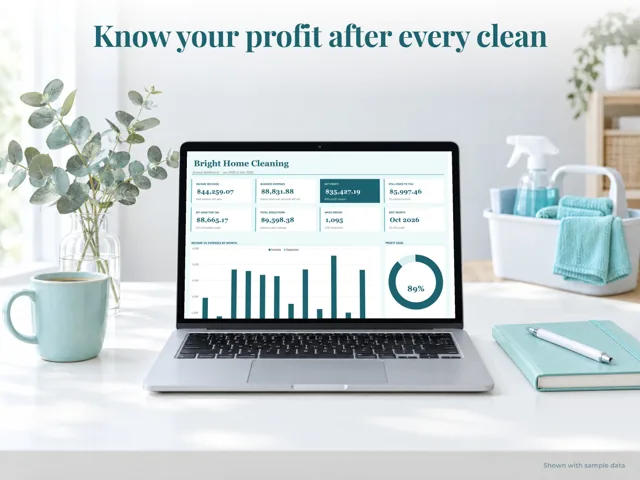
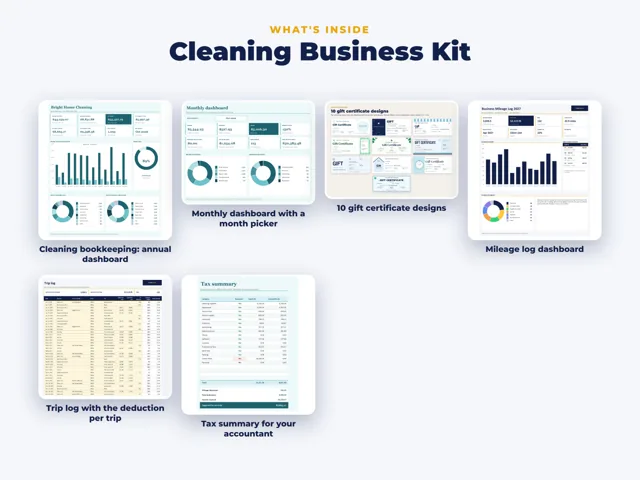
A spreadsheet is enough at the start. The cleaning business bookkeeping spreadsheet has a START HERE tab, Settings, dashboards, Income, Expenses, Mileage, Unpaid Invoices, Top Clients, a Monthly Summary, Quarterly totals and a Tax Summary, in Excel and Google Sheets. For more on building the habit, read how to track business expenses.
7. A simple 30-day launch plan
Days 1 to 7: decide and register - Pick your main service and service area. - Choose a name, check it is free in your state, and register it if needed. - Apply for any city or county license. Get insurance quotes. - Open a separate bank account.
Days 8 to 14: set up - Buy your supply kit and test your routine on your own home. - Time yourself so your prices are based on real hours. - Write your price list (recurring, deep clean, move out, add-ons). - Set up your bookkeeping spreadsheet and mileage log.
Days 15 to 21: tell people - Post in local groups, hand out flyers and set up a free business listing. - Message 20 people you know and ask for referrals. - Offer a few first-time deep cleans to build reviews.
Days 22 to 30: clean, learn and adjust - Do your first paid jobs. Write down how long each one really took. - Adjust prices if jobs take longer than planned. - Ask for reviews and referrals. - At the end of the month, check income, expenses and profit.
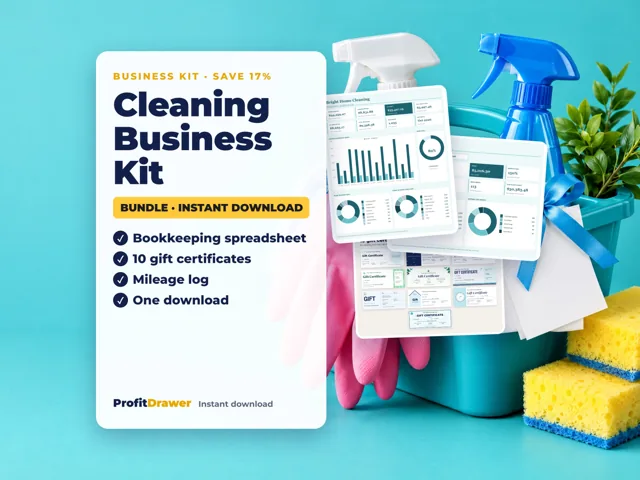
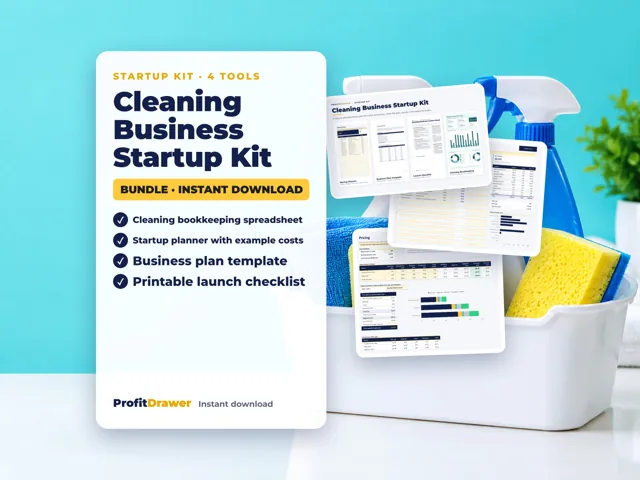
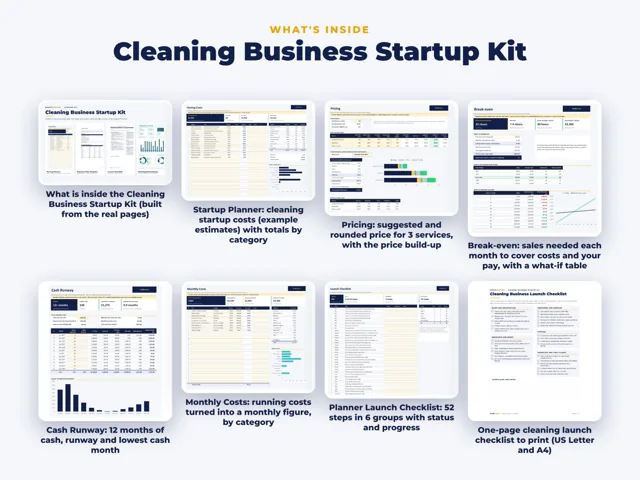
If you want everything in one place, the cleaning business kit bundles the bookkeeping spreadsheet with client gift certificates and a mileage log. The coming-soon cleaning business startup kit adds a Startup Planner workbook for startup costs, pricing, break-even and cash runway, a business plan template and a launch checklist.
Common mistakes to avoid
- Pricing too low to win the first clients. Raising prices later is harder than starting fair.
- Ignoring travel time. Jobs spread across town eat your hourly pay. Keep a tight service area.
- Mixing personal and business spending. It hides your real profit and makes taxes harder.
- Skipping insurance. One broken item or accident can cost more than a year of premiums.
- Not saving for taxes. Put a share of every payment aside so quarterly payments are not a shock.
Starting a cleaning business is one of the most approachable ways to work for yourself. Start small, price each job on real numbers, and keep clean records, and you will know exactly how your business is doing every month.
Tools for this
Questions people ask
How much does it cost to start a cleaning business?
It depends on whether you clean homes or offices and how much equipment you already own. A solo house cleaner who uses their own car can often start for a few hundred dollars in supplies plus insurance and a local license. Our example budget below runs from about $550 to $3,500, but your costs will differ, so add up your own numbers with the free startup cost calculator.
What licenses are needed to start a cleaning business?
Most cleaning businesses need a general business license from their city or county, and some states also want a state registration or sales tax permit. Rules change from place to place, so check with your city, county and state before your first job. The SBA page on licenses and permits explains which level of government handles what.
How much does a cleaning business make a month?
It depends on how many jobs you book and what you charge. For example, a solo cleaner doing 12 recurring homes every two weeks at $140 a visit brings in about $3,640 a month before expenses (12 homes x 26 visits a year x $140, divided by 12 months). Supplies, gas, insurance and taxes come out of that.
Do I need an LLC to start a cleaning business?
No. Many cleaners start as sole proprietors under their own name. An LLC can separate business and personal liability, but it costs a state filing fee and may come with yearly reports. Compare the cost in your state and talk to a local professional if you are unsure.
Is starting a cleaning business profitable?
It can be, because the startup costs are low and many clients book on a recurring schedule. Profit comes down to pricing each job so it covers your time, supplies, travel and taxes. Track every job and expense from the start so you can see your real profit each month.
Sources
- Launch your business: Apply for licenses and permits (U.S. Small Business Administration)
- Launch your business: Register your business (U.S. Small Business Administration)
- Plan your business: Calculate your startup costs (U.S. Small Business Administration)
- Get an employer identification number (IRS)
- Self-employment tax (Social Security and Medicare taxes) (IRS)
- Standard mileage rates (IRS)
General information, not tax, legal or financial advice. Check the rules for your state and your situation.