
To start a courier business, pick a niche (legal documents, medical specimens and supplies, auto parts, same-day business deliveries), register your business, get commercial auto insurance and ask your target clients what training and paperwork they require. Then price each run by the mile and by wait time, win a few regular routes from local businesses and log every mile. You can start with the car or small van you already own.
This guide gives you the steps, an example budget, a worked pricing example and a 30-day launch plan.
1. Pick your courier niche
General "we deliver anything" couriers compete on price. A niche lets you charge more and win regular routes.
- Medical courier: lab specimens, prescriptions, medical supplies and records between clinics, labs, pharmacies and hospitals. Clients care about timing, handling and privacy.
- Legal courier: court filings, signed documents and records for law offices and title companies.
- Auto parts and industrial: parts runs for repair shops, dealerships and contractors.
- Same-day business delivery: florists, print shops, bakeries and local stores that need fast deliveries.
- Scheduled routes: banks, pharmacies or offices that need the same pickup every day.
Pick one or two to start. Medical and legal work often comes with set routes and steady weekly income once you prove you are reliable.
2. Check rules, insurance and client requirements
This is general information. Confirm details with your state and your clients.
- Business registration. Register an LLC with your state or a DBA with your county if you use a business name. The SBA explains the options.
- Business license. Many cities and counties require a general business license. Check your local government websites.
- EIN. Free from the IRS and useful for your bank account and client paperwork.
- Commercial auto insurance. Personal car insurance may not cover business deliveries. Ask your agent about commercial auto, and cargo or general liability coverage if clients require it.
- Vehicle size and DOT rules. Under federal rules, a vehicle used in interstate commerce with a weight rating of 10,001 pounds or more counts as a commercial motor vehicle. Most courier cars and small vans are well under that, but if you use a larger truck or cross state lines, check FMCSA's registration pages for USDOT number and operating authority rules, and ask your state DOT.
- Medical courier requirements. There is not one national license for medical couriers. Labs, clinics and pharmacies often require bloodborne pathogen and specimen handling training, privacy training, a background check and proof of insurance. Some also need temperature-controlled coolers. Ask each client for their list in writing.
3. Startup costs: an example budget
This example budget, your costs will differ, compares a car you already own with buying a used cargo van.
| Item | Low (your own car) | High (used cargo van) |
|---|---|---|
| Vehicle down payment or purchase | $0 | $12,000 |
| Commercial auto insurance (down payment) | $300 | $2,500 |
| Business registration and license | $50 | $400 |
| Phone, mount and route app | $100 | $500 |
| Hand truck, bins, straps | $100 | $500 |
| Medical coolers and spill kit (if needed) | $0 | $600 |
| Training courses clients ask for | $0 | $500 |
| Magnetic signs, business cards, website | $100 | $800 |
| First month of fuel and upkeep | $300 | $1,200 |
| Total | $950 | $19,000 |
Use the free startup cost calculator to total your own list.
4. How to price courier runs
Most couriers charge a base rate plus a per mile rate, with extra for rush service, wait time, after hours and special handling.
Worked example: a same-day run
- Base rate: $20
- Distance: 18 loaded miles x $1.75 = $31.50
- Wait time over 15 minutes: 20 minutes at $0.50 per minute = $10
- Price: $20 + $31.50 + $10 = $61.50
Now check your cost. You drive 18 miles loaded plus 12 miles back, 30 miles in total. If your car costs about $0.45 per mile in fuel, wear and insurance, that is 30 x $0.45 = $13.50. The run leaves you $61.50 - $13.50 = $48.00 for about one hour of work, before taxes.
Routes. For a daily route, quote a flat monthly price. Example: 5 stops a day, 22 days a month, 40 miles a day. If you want at least $25 an hour and the route takes 2 hours, plus $0.45 a mile cost:
- Time: 2 hours x $25 x 22 days = $1,100
- Miles: 40 x $0.45 x 22 days = $396
- Minimum monthly route price: $1,496. Round up to leave room for profit, for example $1,650.
The free price per job calculator helps you test rates like these.
5. Find your first clients
- Walk in with a one page price sheet. Visit law offices, title companies, auto repair shops, print shops, florists and independent pharmacies near you.
- Medical clients. Start with independent labs, small clinics, dental and veterinary offices. Ask who handles their courier work and what would make them switch.
- Be the backup. Many businesses already have a courier. Offer to cover rush runs and overflow; reliable backups often become the main courier.
- A free map search business profile and a simple website with your service area and hours.
- Ask for referrals. Offices in the same building or trade often talk to each other.
6. Track every mile, run and invoice
Couriers drive a lot of miles, so mileage records are a big deal at tax time.
- Log every business mile with date, start, end and purpose. The IRS business standard mileage rate was 72.5 cents per mile from January to June 2026 and 76 cents per mile from July to December 2026. Check the IRS page for the 2027 rate.
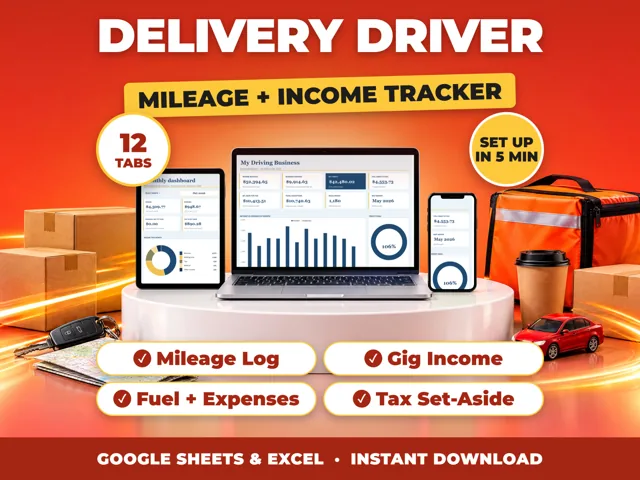
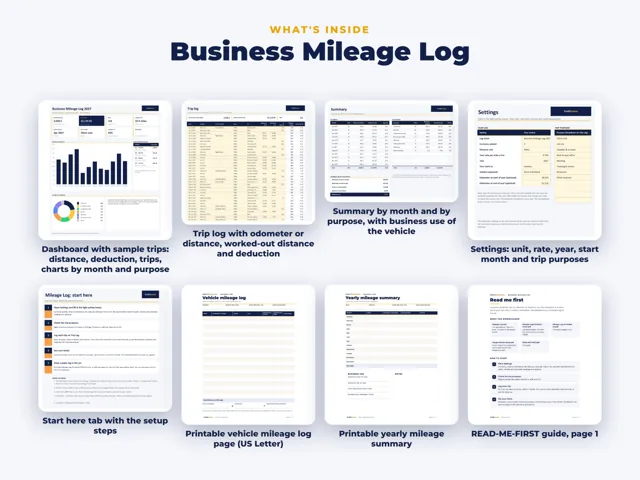
- Keep a mileage log in the car, or use the delivery driver mileage and income tracker if you also drive for delivery apps.
- Send invoices on a schedule and follow up on unpaid ones every week.
- Keep receipts for tolls, parking, supplies and repairs. Our guide on how to track business expenses shows a simple routine.
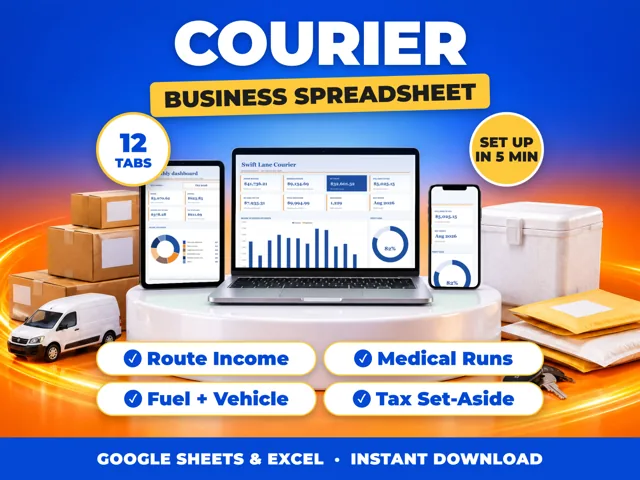
You can track income, expenses, mileage, unpaid invoices, top clients and a tax summary in a spreadsheet like the courier business spreadsheet, with a dashboard, monthly summary and quarterly view. It works in Excel and Google Sheets. It does not dispatch drivers or send invoices.
Taxes. As a self-employed courier you generally pay self-employment tax of 15.3% plus income tax on your profit, and you may need quarterly estimated payments if you expect to owe $1,000 or more. See the 2027 small business tax deadlines and estimate your set-aside with the free self-employed tax calculator. This is general information, not tax advice.
7. A 30-day launch plan
Week 1: niche and paperwork
- Choose your niche and service area.
- Register the business, get a free EIN and open a business bank account.
- Get commercial auto insurance quotes.
Week 2: requirements and setup
- Call three target clients and ask what they require (training, insurance, background check).
- Complete the training and buy only the equipment your clients need.
- Set your base rate, per mile rate and wait time charge.
Week 3: sales
- Visit 20 local businesses with your price sheet.
- Set up your map profile and business cards.
- Set up your bookkeeping spreadsheet and mileage log.
Week 4: first runs
- Do your first runs on time, every time.
- Ask satisfied clients about a regular route.
- Review your miles and income at the end of the month.
Thinking about bigger loads and a larger vehicle later? Read how to start a box truck business.
Key takeaways
- A niche like medical or legal courier work helps you win steady routes.
- Get commercial auto insurance and ask clients for their requirements in writing.
- Price with a base rate plus miles and wait time, and check every rate against your cost per mile.
- Log every mile and receipt and set money aside for taxes from the first run.
Tools for this




Questions people ask
How much does it cost to start a courier business?
It depends on whether you use a car you already own or buy a cargo van. Many owners start with their own vehicle and spend a few hundred to a few thousand dollars on commercial auto insurance, registration, a phone mount, carts and marketing. The example budget in this guide lists the common costs so you can price your own.
What certifications do I need to start a medical courier business?
There is not one single license for every medical courier, so ask your state and the clients you want to serve. Labs, clinics and pharmacies often require training such as bloodborne pathogen and specimen handling training, plus a background check and proof of insurance. Get their requirements in writing before you buy courses or equipment.
How much does a medical courier business make?
It depends on your rates, how many runs you do and your costs. For example, 8 runs a day at $35 each over 21 working days is $5,880 a month; if fuel, wear and insurance cost $1,600, you keep $4,280 before taxes. Regular routes with a few clinics are usually steadier than one-off runs.
Do I need an LLC to start a courier business?
No, many couriers start as sole proprietors, but an LLC can separate business and personal finances and some clients prefer working with one. Registration rules and fees depend on your state. Ask a local attorney or accountant which setup fits you.
Do I need a USDOT number for a courier business?
Most courier cars and small vans weigh far less than the 10,001 pound line where federal commercial vehicle rules start for interstate work. If you use a larger truck or cross state lines, check FMCSA's registration pages and your state DOT. Your state may also have its own rules for commercial vehicles.
Sources
General information, not tax, legal or financial advice. Check the rules for your state and your situation.