
To start a food truck business, choose a short menu you can serve fast, call your county health department to learn the permits and commissary rules, and budget for a truck or trailer that already passes inspection. Then price every plate from its food cost, line up your first locations and events, and track daily sales and expenses from the first service.
Food trucks are a real restaurant on wheels, with restaurant rules. The steps below put them in the order that saves the most money and the most headaches.
Step 1: Pick a concept and a tight menu
A food truck kitchen is small and the line moves fast. The trucks that work usually sell one clear idea with 5 to 8 items.
- Choose one concept: tacos, smash burgers, wood fired pizza, Asian street food, breakfast burritos, coffee and pastries.
- Design for speed: every item should be ready in a few minutes from prepped ingredients. Aim for a ticket time your lunch crowd will accept.
- Share ingredients across items: the same protein in a taco, a bowl and a burrito lowers waste and food cost.
- Plan your service types: street lunch, breweries and evening spots, festivals, private catering, corporate lunches. Catering and private events are often the most predictable income.
Test the menu on friends and family and time yourself cooking it in a small space.
Step 2: Learn your local rules before you buy a truck
This is the step people skip, and it is the most expensive one to get wrong. Food safety rules are written by states and localities, and many base them on the FDA Food Code, but the details differ from place to place. Before you buy a truck, call or visit your county or city health department and ask:
- What do I need for a mobile food unit permit, and will you review my plans first?
- Do I need a commissary (a licensed kitchen where you prep, store food, fill water and dump waste), and how often must I go there?
- What food safety certificate does the owner or person in charge need?
- What equipment is required on the truck: hand sink, three compartment sink, water tank sizes, hot water, refrigeration?
Then check the rest with your city, county and state (SBA licenses and permits):
- A general business license and sales tax registration.
- A fire safety inspection if you cook with propane or have a fryer.
- Parking and vending rules: where you may park, how long, distance from restaurants, and permits for each city you serve.
- Vehicle registration and commercial auto insurance.
Register your business name or LLC (SBA register your business), get a free EIN from the IRS (EIN page) and open a business bank account.
Step 3: Startup costs
Here is an example budget for a used food truck. Your costs will differ a lot by city and by truck, so replace every line with real quotes.
| Item | Low | High |
|---|---|---|
| Used truck or trailer with kitchen | $25,000 | $100,000 |
| Equipment repairs or additions | $1,000 | $10,000 |
| Wrap, menu boards and signage | $1,500 | $7,000 |
| Health, fire and business permits | $500 | $3,000 |
| Commercial auto and liability insurance (first months) | $1,000 | $4,000 |
| Commissary deposit and first month | $400 | $2,000 |
| Point of sale device and card reader | $100 | $1,500 |
| Opening food, packaging and propane | $1,500 | $5,000 |
| Generator (if not built in) | $1,000 | $6,000 |
| Cash reserve for slow weeks | $2,000 | $10,000 |
| Total | $34,000 | $148,500 |
Run your own numbers in the free startup cost calculator. The SBA's plan your business page is a good checklist of one time and monthly costs, including the break even point.
Step 4: Price each plate from food cost
Start with what goes on the plate, then work up. Here is a worked example for a plate of two brisket tacos with a side:
- Ingredients: tortillas $0.40, brisket $2.60, toppings and salsa $0.55, side $0.60 = $4.15.
- Packaging, napkins and utensils: $0.35.
- Total plate cost: $4.15 + $0.35 = $4.50.
- Target food and packaging cost of 32% of the price: $4.50 / 0.32 = $14.06.
- Round to a clean menu price: $14.00. At $14, food and packaging are $4.50 / $14 = 32.1% of the price.
Then check a full day. If you sell 100 plates at $14, that is $1,400 in sales. Food and packaging at $4.50 x 100 = $450 leaves $950 for fuel, propane, commissary, permits, insurance, card fees, labor, loan payments and your pay. If those fixed and daily costs come to $600 a day, you keep $350 before tax. Selling 30 fewer plates on a slow day takes $285 off that, which is why location and events matter so much. Try your own plate costs and daily numbers in the free price per job calculator.
Step 5: Find your locations and first customers
- Book private events first. Weddings, office lunches and parties pay a guaranteed minimum and fill weekdays.
- Partner with breweries, apartment complexes and office parks that do not have a kitchen.
- Apply to festivals and markets early in the season; many fill up months ahead.
- Post your weekly schedule every Monday on your social pages and a simple website, and keep a free map listing updated.
- Collect a customer list with a sign up sheet or a loyalty punch card so you can tell regulars where you will be.
Track sales by location and day. After a month you will know which spots are worth the drive.
Step 6: Track money and taxes from day one
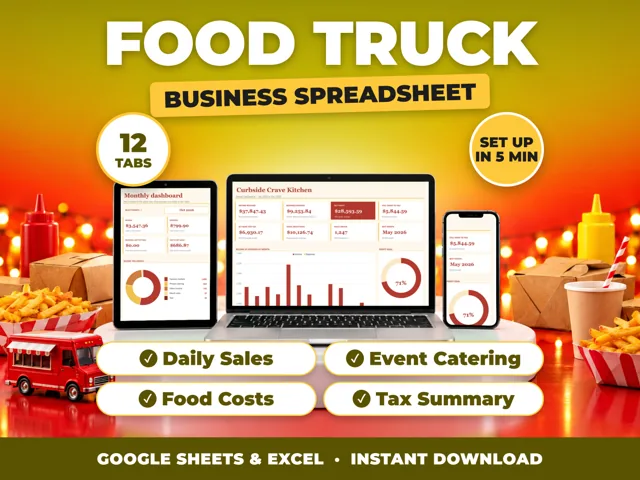
A food truck has many small daily costs: propane, ice, commissary fees, fuel, card fees. If you do not write them down weekly, you will not know your real profit. A spreadsheet like the food truck business spreadsheet gives you Income, Expenses, Mileage and Unpaid Invoices tabs (handy for catering balances), a dashboard, Top Clients, a Monthly Summary and a Quarterly and Tax Summary, in Excel or Google Sheets. It does not run your register, track inventory or do payroll. See how to track business expenses for a simple weekly routine.
Remember sales tax: in most places you collect it on food sales and file returns with your state on its schedule. On federal taxes, if you run the truck as a sole proprietor or single member LLC you generally owe self-employment tax of 15.3% on net earnings of $400 or more (IRS self-employment tax), plus income tax, and quarterly estimated payments if you expect to owe $1,000 or more (IRS estimated taxes). The 2027 small business tax deadlines list the dates, and the free self-employed tax calculator helps you set money aside. If you hire staff, payroll taxes and filings apply too. This is general information, not tax advice.
A simple 30 day launch plan
This plan assumes you have your concept and a realistic budget. Truck build outs and permit reviews can take longer than a month, so start the permit calls as early as you can.
Week 1: Rules and numbers. Call the health department, fire marshal and city clerk. Write down every permit, the order and the fees. Finish your startup cost list and plate cost sheet.
Week 2: Truck and kitchen. Inspect trucks against the health department's equipment list before you buy. Sign a commissary agreement. Register the business, get an EIN, open a bank account, buy insurance.
Week 3: Inspections and menu. Submit plans, pass the health and fire inspections, finish your food safety certificate. Lock the menu and prices. Order the wrap and menu board.
Week 4: Soft open. Do a friends and family service, then 2 or 3 public services at different spots. Book your first private event. Record every sale and expense in your bookkeeping spreadsheet.
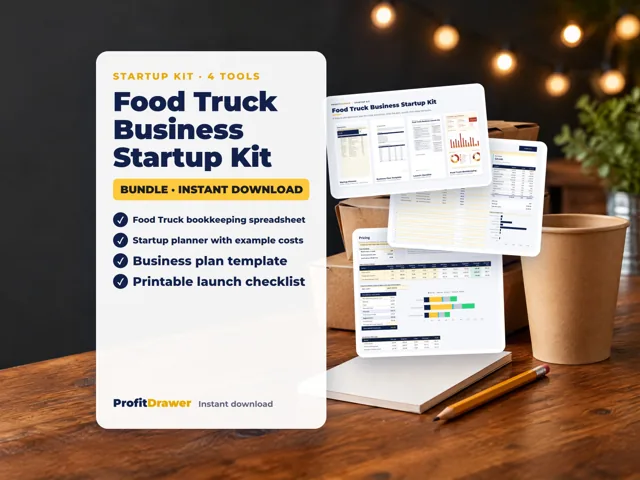
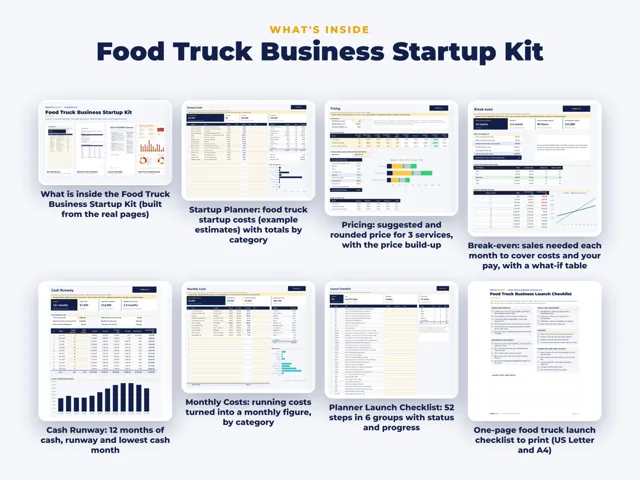
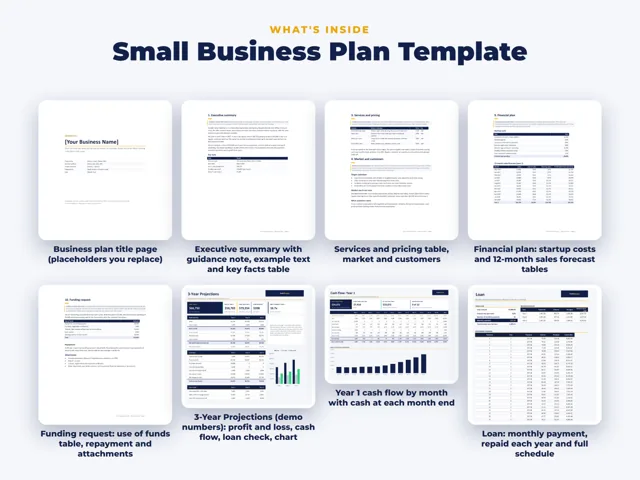
Want the planning side done in one place? The food truck business startup kit bundles the food truck spreadsheet with a Startup Planner workbook for startup costs, pricing, break even and cash runway, a business plan template and a launch checklist. If a lender wants a plan, the small business plan template is also available on its own.
Tools for this



Questions people ask
How much does it cost to start a food truck business?
It depends most on the truck. A used truck or trailer with working equipment costs far less than a new custom build, and permits, insurance, the commissary and your first inventory come on top. The example budget in this guide runs from about $34,000 to $148,500. Price your own list with the free startup cost calculator before you sign anything.
Do food trucks make money?
Many do, but the margin comes from food cost, how many plates you sell per service and how many days you work. For example, 100 plates at $14 is $1,400 for one service. After food and packaging at about 32% of sales ($450) you keep about $950 to cover fuel, commissary rent, permits, insurance, loan payments, labor and your own pay.
Can I start a food truck business with no money?
It is hard to start a food truck with nothing, because the truck, permits and insurance must be paid for before you sell a plate. Lower cost paths include renting a truck or trailer, starting with a tent at farmers markets or events where your local rules allow it, or catering from a licensed kitchen first to build cash and a customer list.
What permits do I need for a food truck?
Rules are set by your state, county and city, and they differ a lot. Most places require a business license, a health permit for the mobile food unit, a food safety certificate for at least one person, a fire inspection if you cook with gas, sales tax registration and rules for where you may park. Call your county health department first; they will tell you the steps.
How do I write a food truck business plan?
Keep it practical. Cover your concept and menu, your target locations and events, a startup cost list, your plate prices and food cost, a weekly sales estimate, and how you will cover the first few slow months. A business plan template saves you from starting with a blank page, and lenders often ask for one.
Sources
- FDA Food Code (U.S. Food and Drug Administration)
- Apply for licenses and permits (U.S. Small Business Administration)
- Register your business (U.S. Small Business Administration)
- Plan your business (U.S. Small Business Administration)
- Get an employer identification number (IRS)
- Self-employment tax (Social Security and Medicare taxes) (IRS)
- Estimated taxes (IRS)
General information, not tax, legal or financial advice. Check the rules for your state and your situation.