

To start a tutoring business, choose the subjects and age group you know best, decide whether you will tutor in person, online or both, check what registration or license your area needs, price each session so it covers your prep time and costs, and find your first students through parents, teachers and people you already know. Most tutors start from home for very little money. The habits that keep you going are fair pricing and clean records from the first session.
This guide walks you through each step in plain language, with an example budget, a worked pricing example and a 30-day launch plan.
1. Choose your subjects and students
Parents look for a tutor who is clearly good at one thing. Start narrow and grow later. Common niches:
- Elementary reading and math: steady demand, often weekly sessions through the school year.
- Middle and high school subjects: algebra, geometry, chemistry, physics, essay writing.
- Test prep: college entrance exams, state tests and placement exams. Higher rates, but seasonal.
- Homework help and study skills: organization, time management and catching up after a hard term.
- Adult learners: languages, career exams, computer skills or high school equivalency prep.
Pick one main niche and one related subject. A tutor who says "high school algebra and geometry" is easier to refer than one who says "any subject, any age".
Then decide where you will teach:
- At the student's home: families like it, but driving takes time.
- At your home: no travel, but you need a quiet, tidy space.
- Online: no travel, a wider area, and you can fit more sessions into a day.
- A library or public space: neutral and free, if your library allows it.
2. Check local requirements and register
A common search is "do you need a license to start a tutoring business". The honest answer is that it depends on where you live and how you set up. The SBA explains that most businesses need some mix of state and local licenses and permits, and that the details depend on your activity and location. Check with your city, county and state before you take paying students.
A simple checklist:
- Pick a business structure. Most tutors start as a sole proprietor. Some form an LLC for liability reasons, which comes with a state filing fee.
- Register your business name. If you use a name other than your own legal name, most states require a DBA ("doing business as") registration.
- Get a general business license from your city or county if they require one, and ask about a home business permit if students come to your home.
- Ask about extra rules for a learning center. If you rent a room or open a center, zoning, building and other rules may apply.
- Be ready for a background check. Many parents, schools and organizations ask tutors who work with children for one, even where it is not a legal rule.
- Think about insurance. General or professional liability coverage protects you if something goes wrong in a session or someone is hurt at your home.
3. Work out your startup costs
Tutoring is one of the cheapest businesses to start. The SBA suggests listing one-time costs separately from monthly costs such as software and phone.
Example budget, your costs will differ:
| Item | Low | High |
|---|---|---|
| Business registration and local license | $0 | $300 |
| Workbooks, practice tests and materials | $50 | $400 |
| Laptop, webcam or headset upgrade (online) | $0 | $800 |
| Whiteboard, tablet or stylus | $0 | $300 |
| Liability insurance (first months) | $0 | $600 |
| Background check | $0 | $100 |
| Simple website, business cards and flyers | $50 | $500 |
| Total | $100 | $3,000 |
If you already own a good computer and teach in subjects where free materials are easy to find, you may sit near the low column. Try your own numbers in the free startup cost calculator.
4. Set your prices
Tutors usually charge per session or per hour, and many sell packages of sessions paid up front. Test prep and advanced subjects often charge more than homework help.
Your price must cover more than the hour with the student. Prep, travel and messages to parents all take time.
Worked pricing example (example numbers only, one in-home session):
- Session length: 1 hour, plus 30 minutes of prep and a short note to the parent, so 1.5 hours of your time
- Your target pay: $30 an hour, so 1.5 x $30 = $45
- Materials and printing: $2
- Driving: 10 miles round trip. Using $0.70 a mile as a rough running cost, 10 x $0.70 = $7
- Share of software, insurance and marketing: about $4 per session
- Cost before profit: $45 + $2 + $7 + $4 = $58
- Add a 20% markup for taxes and cancelled sessions: $58 x 1.20 = $69.60
- Round to a price of $70 per in-home session
For an online session there is no driving: $45 + $2 + $4 = $51, and $51 x 1.20 = $61.20, so a price of $62 or $65 works. The free price per job calculator runs this math for you. Check local rates so your price is in a sensible range, and write a clear policy for late cancellations.
5. Get your first students
Your first students usually come through trust, so start with the people who already know you.
- Parents you know. Tell friends, neighbors and coworkers with school-age children.
- Teachers and school staff. They often get asked for tutor names. Leave a short note with your subjects and contact details.
- Libraries, community centers and places of worship. Ask about notice boards.
- Local community groups. Post a short intro with your subjects, grades and area.
- A free business profile on map and search listings.
- Referral reward: for example, one free session for each new student who signs up for a package.
Share a short progress note after each session. Parents who see progress tell other parents.
6. Track your money and plan for taxes
Keep business money separate from personal money. A separate checking account makes tax time far easier.
Track these every week:
- Income from each student, and which families still owe you
- Expenses such as materials, software, insurance, phone and advertising
- Mileage for in-home sessions and trips to buy supplies. The IRS business standard mileage rate for 2026 was 72.5 cents a mile from January to June and 76 cents a mile from July to December. Check the 2027 rate on irs.gov before you file.
As a self-employed tutor you pay self-employment tax of 15.3% on net earnings (Social Security plus Medicare), on top of income tax, and you may need to make quarterly estimated payments. Our guide to small business tax deadlines for 2027 lists the dates, and the free self-employed tax calculator helps you estimate what to set aside. This is general information, not tax or legal advice.
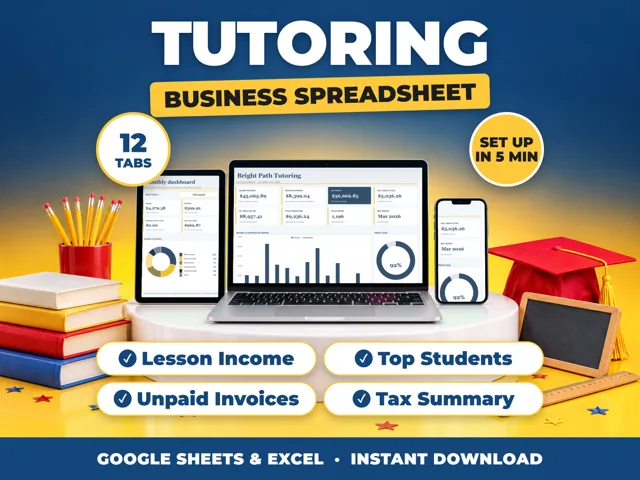
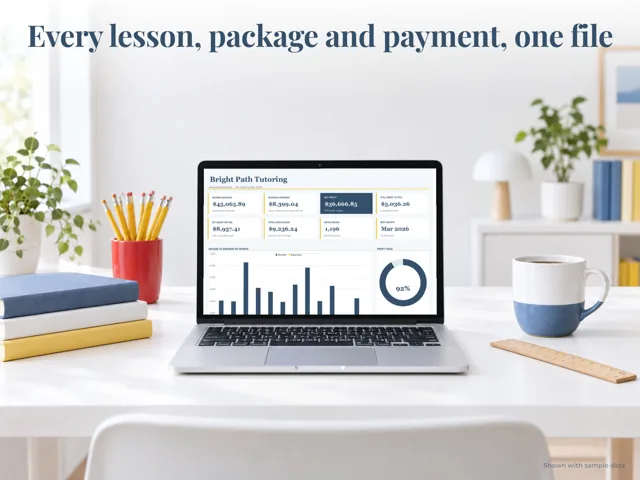
The tutoring business spreadsheet has a START HERE tab, Settings, dashboards, Income, Expenses, Mileage, Unpaid Invoices, Top Clients, a Monthly Summary, Quarterly totals and a Tax Summary, in Excel and Google Sheets. It does not schedule sessions or send invoices, so keep a calendar for bookings. For an easy weekly routine, read how to track business expenses.
7. A simple 30-day launch plan
Days 1 to 7: decide and register - Choose your subjects, grades and where you will teach. - Check license and permit rules with your city, county and state. - Register your name if needed and open a separate bank account.
Days 8 to 14: set up - Gather materials and plan a first session you can reuse. - Test your online setup with a friend. - Write your price list, packages and cancellation policy. - Set up your bookkeeping spreadsheet and mileage log.
Days 15 to 21: tell people - Message 20 parents you know and ask for referrals. - Contact teachers, libraries and community centers. - Set up a free business listing and post in local groups.
Days 22 to 30: teach, learn and adjust - Run your first sessions and time your prep honestly. - Send a short progress note after each one. - At day 30, check income, expenses and profit, and adjust prices if needed.
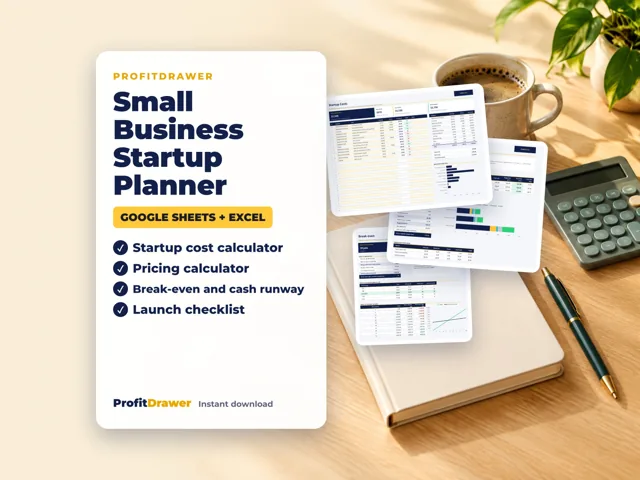
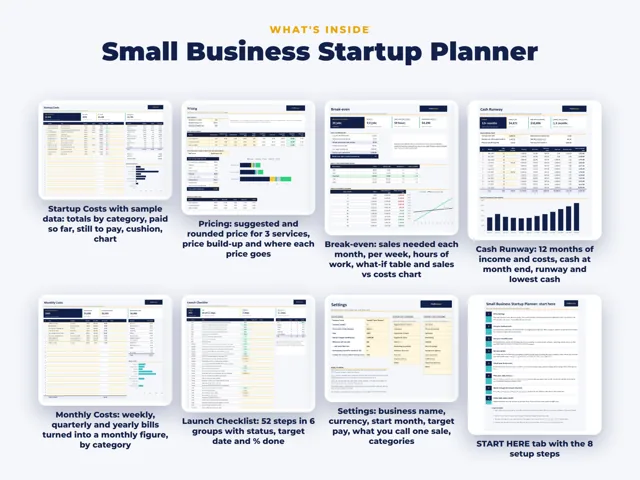
If you plan to rent a room or open a small center later, the coming-soon small business startup planner helps you work out startup costs, pricing, break even and cash runway in one workbook.
Common mistakes to avoid
- Charging only for the hour in the room. Prep and travel are part of the job.
- Teaching every subject. A clear niche is easier to refer and easier to price.
- No cancellation policy. Last-minute cancellations quietly cut your income.
- Driving across town for one session. Group nearby students or move some online.
- Not saving for taxes. Set aside a share of every payment for quarterly payments.
A tutoring business is a simple, low-cost way to work for yourself. Start with what you teach best, price your full time, and keep clean records so you always know how the business is doing.
Tools for this

Questions people ask
Do you need a license to start a tutoring business?
It depends on where you live and how you set up the business. Many areas ask for a general business license or registration for any business, and some have extra rules if you open a learning center or work with children in a building you run. Check with your city, county and state before you take paying students.
How do I start a tutoring business from home?
Pick one or two subjects you know well, set up a quiet space or an online setup, and decide whether students come to you, you go to them, or you meet online. Check whether your city needs a home business permit, set a session price and tell parents and teachers you know. Track every session and expense from the start.
How do I start an online tutoring business?
You need a reliable computer, webcam, headset and internet connection, a video call tool and a way to share notes or a whiteboard on screen. Online tutoring removes driving time, so you can fit more sessions into a day. Price your sessions on your time and costs, not only on what others charge.
How much should I charge for tutoring?
Start from the pay you want for your time, including prep and follow-up, then add materials, travel and a margin for taxes. For example, 1.5 hours of time at $30 an hour plus $13 of costs is $58, and adding 20% gives $69.60, which rounds to $70 a session. Check local rates so your price is in a sensible range.
Is a tutoring business profitable?
It can be, because startup costs are low and students often book weekly for a whole term. Profit comes from pricing each session to cover your full time, keeping travel short and selling packages that keep students coming back. Record every session so you can see your real profit each month.
Sources
- Launch your business: Apply for licenses and permits (U.S. Small Business Administration)
- Launch your business: Register your business (U.S. Small Business Administration)
- Plan your business: Calculate your startup costs (U.S. Small Business Administration)
- Self-employment tax (Social Security and Medicare taxes) (IRS)
- Standard mileage rates (IRS)
General information, not tax, legal or financial advice. Check the rules for your state and your situation.