
To start a t-shirt business, pick a niche and a small set of designs, then decide whether you will print shirts yourself at home or use print on demand, where a partner prints and ships each order for you. Register your business, check local license and sales tax rules, and price every shirt so it covers the blank, printing, fees, your time and a profit. Start selling in one place, such as an Etsy shop or local markets, and track every sale and expense from the first order.
This guide walks you through each step, with an example budget, a worked pricing example and a 30-day launch plan.
1. Choose your niche and designs
A t-shirt is easy to make and hard to sell if it looks like every other shirt. The fix is a clear niche: a group of people with a shared interest, job, place or sense of humor. Examples include nurses, teachers, a hobby, a hometown, a pet breed or a family event like reunions.
Start with 5 to 10 designs for one niche. Use only artwork, fonts and phrases you have the right to use. Do not put other people's logos, characters, song lyrics or brand names on your shirts. Check the license on any font or graphic you buy, since some do not allow use on products for sale.
2. Decide how you will make the shirts
This is the biggest choice in a t-shirt business, and it shapes your costs, profit and daily work.
Printing at home
- You buy blank shirts and put the design on yourself, often with a heat press and printed transfers or cut vinyl. Some people later add screen printing for larger batches.
- Higher profit per shirt and full control over quality and speed.
- You pay for equipment and stock up front, and you store shirts in many sizes and colors.
- You pack and ship every order yourself.
Print on demand
- You upload designs, and a print partner makes and ships each shirt only after a customer orders it.
- Very low startup cost and no stock to store. This is the usual answer to "how to start a tshirt business from home with no money".
- Lower profit per shirt, and you rely on someone else for quality and shipping times.
- Order a sample of every design and color so you know what customers will receive.
Many sellers start with print on demand to test which designs sell, then print their best sellers at home for a better margin.
3. Check local requirements and register
Rules depend on where you live, so check with your city, county and state before you sell. The SBA explains that most businesses need some mix of state and local licenses, and that the rules depend on your activity and location.
- Pick a business structure. Many sellers start as a sole proprietor. The SBA notes you do not need to register anywhere if you trade under your own legal name, but most states require a DBA if you use a different name.
- Get a general business license if your city or county requires one. Ask whether a home business needs a separate home occupation permit.
- Ask about sales tax. Contact your state revenue department about a seller's permit and how sales on marketplaces, at markets and on your own site are handled.
- Know the label rules. The FTC says clothing labels must show fiber content, country of origin and the maker or dealer's name or RN number, and a separate FTC rule requires care instructions. If you remove or replace the label in a blank shirt, read the FTC's textile labeling guide first.
- Get an EIN from the IRS for free if you hire or form a partnership or corporation.
4. Work out your startup costs
The SBA suggests listing one-time costs, like equipment and permits, separately from monthly costs. This example is for printing at home with a heat press. Print on demand can start much lower.
Example budget, your costs will differ:
| Item | Low | High |
|---|---|---|
| Heat press | $150 | $600 |
| Cutting machine or transfer printer (optional) | $0 | $500 |
| Starter stock of blank shirts | $100 | $400 |
| Transfers, vinyl or ink | $50 | $300 |
| Mailers, tags and labels | $30 | $150 |
| Design software, fonts and graphic licenses | $0 | $200 |
| Business registration and local license | $50 | $300 |
| Samples and product photos | $20 | $150 |
| Marketing | $0 | $300 |
| Total | $400 | $2,900 |
Put your own numbers into the free startup cost calculator to see your total before you spend.
5. Price each shirt
Price from your costs up, not from what the cheapest seller charges. Include marketplace and payment fees in the price, since they come out of every sale. Read the current fees for wherever you sell.
Worked pricing example, printing at home (example numbers only):
- Blank shirt: $4.50
- Transfer or vinyl for the design: $2.00
- Mailer and tag: $0.80
- Your time to press, fold and pack: 15 minutes at $25 an hour, so $25 x 0.25 = $6.25
- Share of equipment, rent and marketing: $1.00
- Cost per shirt: $4.50 + $2.00 + $0.80 + $6.25 + $1.00 = $14.55
- Add a 30% markup for profit and slow weeks: $14.55 x 1.30 = $18.92 (rounded)
- Cover an example 10% in selling and payment fees: $18.92 / 0.90 = $21.02
- Round to a price of $22 per shirt, plus shipping
Check: $22 minus 10% fees ($2.20) is $19.80. Minus the $14.55 cost leaves $5.25 profit per shirt, on top of the $6.25 you paid yourself.
Print on demand comparison (example numbers only): if the partner charges $12.50 for the shirt and $4.50 to ship it, your cost is $12.50 + $4.50 = $17.00. At a $26 price with free shipping, 10% fees are $2.60, so you keep $26.00 minus $2.60 minus $17.00 = $6.40, with no time spent pressing or packing.
The free price per job calculator can run this math for each design.
6. Get your first customers
- Start where your niche already gathers. Local clubs, teams, schools, churches, workplaces and online groups for the interest you chose.
- Sell on Etsy. Write titles and descriptions in the words buyers search for, show clear photos or mockups, list sizes and care details, and keep your shop focused on one niche.
- Local markets and pop-ups. You get instant feedback on which designs people pick up.
- Group and custom orders. Reunions, small teams and local businesses often order in batches.
- Social posts with real photos. Show the shirt on a person, not just a flat mockup.
7. Track your money and plan for taxes
Keep business money in a separate account from day one. Track these every week:
- Income from each sale and channel
- Expenses like blanks, transfers, fees, packaging and equipment. The IRS says materials that become part of the products you sell are part of cost of goods sold
- Mileage for supply runs, markets and post office trips. The IRS business standard mileage rate for 2026 was 72.5 cents a mile from January to June and 76 cents a mile from July to December. Check the 2027 rate on irs.gov before you file.
If you are self-employed, you pay self-employment tax of 15.3% on net earnings once they reach $400 or more, on top of income tax. If you expect to owe $1,000 or more, the IRS says you generally need to pay estimated tax in four payments through the year. Our guide to small business tax deadlines for 2027 and the free self-employed tax calculator can help you plan. This is general information, not tax or legal advice.
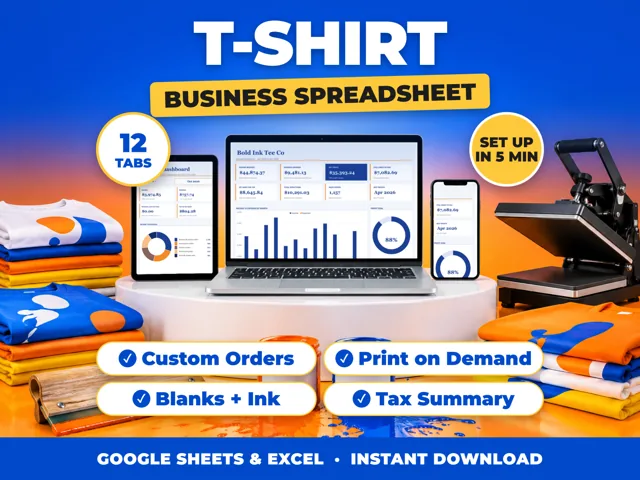
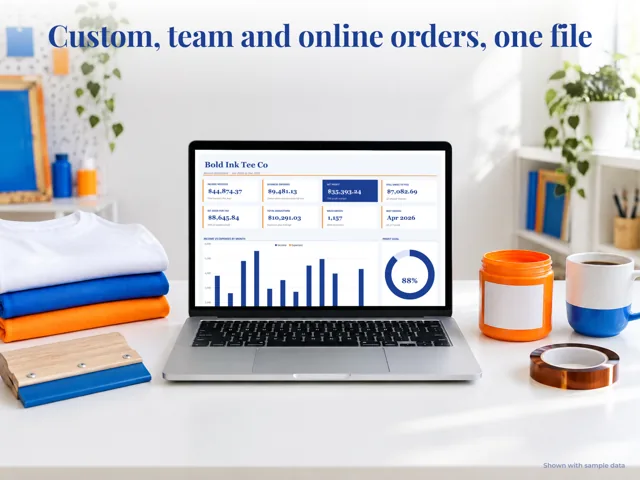
The t-shirt business spreadsheet gives you a START HERE tab, Settings, dashboards, Income, Expenses, Mileage, Unpaid Invoices, Top Clients, a Monthly Summary, Quarterly totals and a Tax Summary, in Excel and Google Sheets. It tracks money, not stock, so keep a simple count of blanks by size and color on its own sheet. For the habit itself, read how to track business expenses.
8. A simple 30-day launch plan
Days 1 to 7: niche and plan - Choose your niche and sketch 10 design ideas. - Decide between printing at home and print on demand. - Check license and sales tax rules. Open a separate bank account.
Days 8 to 14: make and test - Finish 5 designs. Order samples or press test shirts. - Wash test shirts several times to check the print holds up. - Work out your price for each shirt.
Days 15 to 21: list and announce - Take photos and open your Etsy shop or market booth. - Tell friends, family and groups in your niche. - Set up your bookkeeping spreadsheet.
Days 22 to 30: sell and adjust - Fill your first orders and note how long each takes. - Ask early buyers for photos and reviews. - At month end, check which designs sold, your fees and your real profit.
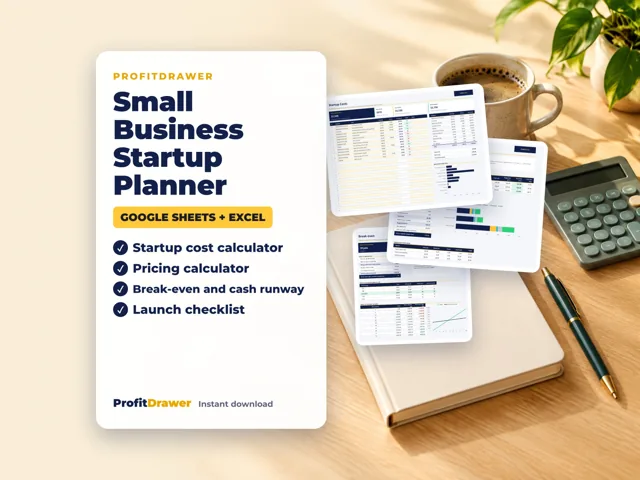
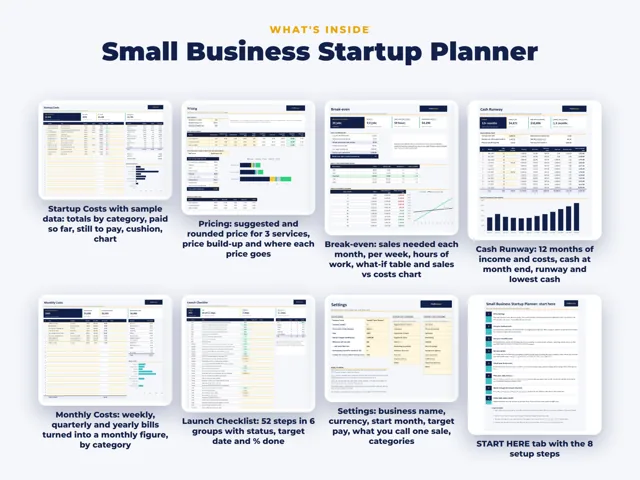
If you want to plan costs, prices, break-even and cash runway in one workbook before you buy equipment, the coming-soon small business startup planner has tabs for each, plus a launch checklist.
Common mistakes to avoid
- Using designs you do not own. It can get listings removed and lead to legal trouble.
- Buying every size and color at once. Start with a few colors and the sizes that sell most.
- Forgetting fees in the price. Fees and shipping supplies quietly eat thin margins.
- Skipping sample orders. A blurry print or a thin shirt costs you reviews.
- Not saving for taxes. Put a share of every sale aside for quarterly payments.
A t-shirt business can start small and grow one design at a time. Pick a niche, test cheaply, price on real numbers and keep clean records, and you will always know which shirts are worth making.
Tools for this


Questions people ask
What do I need to start a t-shirt printing business at home?
At the simplest level you need designs, blank shirts, a way to put the design on the shirt (often a heat press with transfers or vinyl) and a place to sell. You also need any business license your city, county and state require. Our example budget below runs from about $400 to $2,900, but your costs will differ.
How do I start a t-shirt business from home with no money?
Print on demand is the lowest cost way to start, because a print partner makes and ships each shirt only after a customer orders. You pay for the shirt when it sells, so you skip buying equipment and stock. The tradeoff is a smaller profit per shirt and less control over quality and shipping times.
How do I start a t-shirt business on Etsy?
Open a shop, decide whether you will print yourself or use print on demand, and list a small set of designs with clear photos or mockups, sizes and care details. Read Etsy's seller fees and policies before you set prices, and build those fees into every price. Start with one niche so your shop looks focused.
How do you make money selling t-shirts?
You make money when each shirt sells for more than the blank, printing, packaging, fees, your time and a share of overhead. Selling in a clear niche helps, because a design that speaks to a specific group sells better than a generic one. Track the profit on each design and drop the ones that do not sell.
Do I need a license to sell t-shirts?
Many places require a general business license, and you may need a seller's permit to collect sales tax. Rules differ, so check with your city, county and state before your first sale. The SBA page on licenses and permits explains which level of government handles what.
Sources
- Launch your business: Apply for licenses and permits (U.S. Small Business Administration)
- Launch your business: Register your business (U.S. Small Business Administration)
- Plan your business: Calculate your startup costs (U.S. Small Business Administration)
- Threading Your Way Through the Labeling Requirements Under the Textile and Wool Acts (FTC)
- Self-employment tax (Social Security and Medicare taxes) (IRS)
- Estimated taxes (IRS)
- Publication 334, Tax Guide for Small Business (IRS)
- Standard mileage rates (IRS)
General information, not tax, legal or financial advice. Check the rules for your state and your situation.