
To start a mobile detailing business, choose a short list of packages you can do well, register your business and check local rules on licenses and wash water, buy a basic mobile kit and insurance, price each package so it covers your time and costs, and book your first cars through people you already know. Many detailers start from home with the car they already drive. What keeps you in business is pricing every job on real numbers and tracking your money from the first day.
This guide walks you through each step in plain language, with an example budget, a worked pricing example and a 30-day launch plan.
1. Choose your detailing services
Start with a few clear packages instead of a long menu. Customers find it easier to choose, and you get faster at each one. Common options:
- Maintenance wash and vacuum: a quick exterior wash, wheels, windows and an interior vacuum. Good for repeat customers every two to four weeks.
- Full interior detail: deep vacuum, shampoo or extraction of seats and carpets, plastics, door jambs and glass.
- Full exterior detail: wash, decontamination, a simple polish and a sealant or wax.
- Paint correction and coatings: higher prices, but they need training, practice and more time per car.
- Fleet work: company vans, dealer lots or rental cars. Steady volume, but clients may want proof of insurance and a written agreement.
Pick one maintenance package, one full detail and one or two add-ons (for example, pet hair removal or headlight restoration). Add more once you have regular customers.
2. Check local requirements and register
Every area has its own rules, so check with your city, county and state before you take paid work. The SBA explains that most businesses need some mix of state and local licenses and permits, and that the details depend on your activity and location.
A simple checklist:
- Pick a business structure. Many detailers start as a sole proprietor. Some form an LLC to separate business and personal liability, which comes with a state filing fee.
- Register your business name. If you work under a name other than your own legal name, most states require a DBA ("doing business as") registration.
- Get a general business license from your city or county if they require one, and ask whether a home business permit applies.
- Ask about wash water. Soapy water and grime that run into a storm drain usually reach local streams without treatment. The EPA explains that cities manage their storm sewers under stormwater permits, and many have rules on what may go down a drain. Check local rules on wash water before your first job. Some detailers use a water reclaim mat or waterless and rinseless products to stay within them.
- Get insurance. You work on expensive property, so general liability is the usual starting point. Ask an agent about coverage for damage to a customer's vehicle while it is in your care.
3. Work out your startup costs
List every cost before you spend anything. The SBA suggests keeping one-time costs (equipment, licenses) separate from monthly costs (insurance, phone, products).
Example budget, your costs will differ:
| Item | Low | High |
|---|---|---|
| Pressure washer, vacuum, polisher and pads | $300 | $1,500 |
| Water tank, pump and hose reels | $150 | $800 |
| Generator or other power setup | $0 | $900 |
| Chemicals, towels, brushes and applicators | $150 | $500 |
| Business registration and local license | $50 | $400 |
| Insurance (first months) | $150 | $700 |
| Marketing, business cards, simple website | $50 | $500 |
| Water reclaim mat or containment | $0 | $400 |
| Total | $850 | $5,700 |
If you plan to offer coatings or work out of a van with a built-in rig, your costs will be higher. Plug your own numbers into the free startup cost calculator to see your total and how long your savings will last.
4. Set your prices
Most detailers price by package and vehicle size (car, small SUV, large SUV or truck), with extra charges for heavy dirt, pet hair or stains. Flat package prices are easy for customers to understand.
To set a package price, start from your time and costs:
Worked pricing example (example numbers only):
- Time for a full interior and exterior detail on a midsize car: 3.5 hours
- Your target pay: $35 an hour, so 3.5 x $35 = $122.50
- Products used per car: $12
- Driving: 16 miles round trip. Using $0.70 a mile as a rough running cost, 16 x $0.70 = $11.20
- Fuel for the generator and water refills: $5
- Share of insurance, phone and marketing: about $10 per job
- Cost before profit: $122.50 + $12 + $11.20 + $5 + $10 = $160.70
- Add a 20% markup for taxes and slow weeks: $160.70 x 1.20 = $192.84
- Round to a price of $195 for a midsize car
A large SUV takes longer, so time it and price it separately. The free price per job calculator does this math for you. Look at what local detailers charge so your price sits in a sensible range, and compete on quality and reliability rather than being the cheapest.
5. Get your first customers
Your first customers will usually come from people who know you or live near you.
- Friends, family and coworkers. Offer to detail their cars and ask each one for a referral.
- Before and after photos. Take them on every job. They sell detailing better than words.
- Local community groups. Post a short intro with photos and your service area.
- A free business profile on map and search listings, with your packages and photos.
- Workplaces and apartment complexes. Ask if you can offer detailing on site for staff or residents.
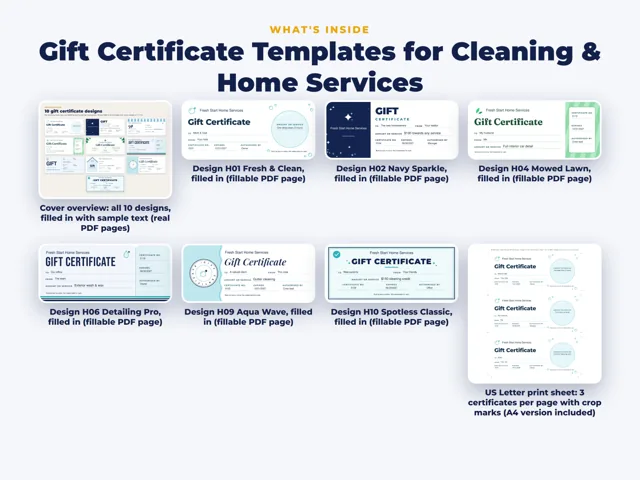
- Gift certificates. Detailing makes a good holiday or birthday gift. The gift certificate templates for cleaning and home services include a detailing design, with a fillable PDF, an editable PPTX and print sheets with three per page. Each one has a Certificate No. field so you can track what you sold.
Ask happy customers for a review the same day, while the car still shines.
6. Track your money and plan for taxes
Keep business money separate from personal money from the first job. A separate checking account makes tax time far easier.
Track these every week:
- Income from each job, and which customers still owe you
- Expenses such as chemicals, towels, equipment, insurance, phone and ads
- Mileage for every drive to a customer and to buy supplies. The IRS business standard mileage rate for 2026 was 72.5 cents a mile from January to June and 76 cents a mile from July to December. Check the 2027 rate on irs.gov before you file.
As a self-employed detailer you pay self-employment tax of 15.3% on net earnings (Social Security plus Medicare), on top of income tax, and you may need to make quarterly estimated payments. See our guide to small business tax deadlines for 2027 and the free self-employed tax calculator to estimate what to set aside. This is general information, not tax or legal advice.
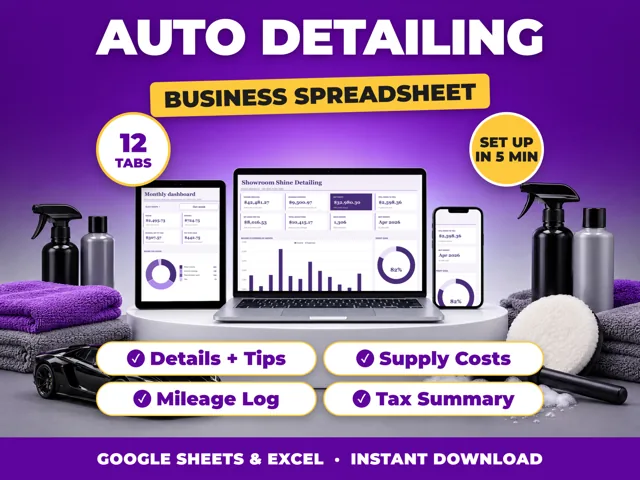
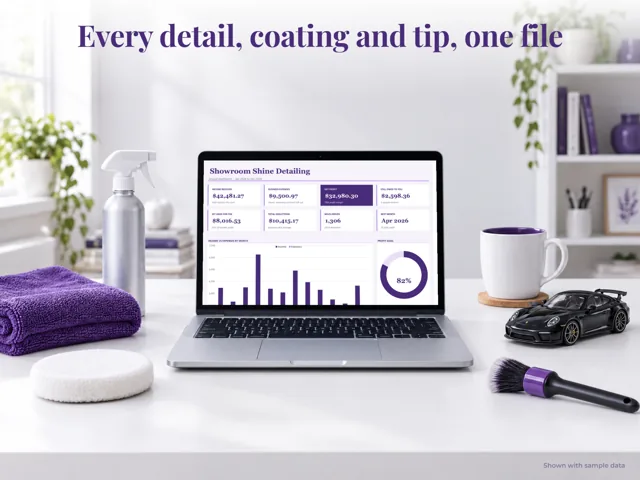
A spreadsheet is enough at the start. The auto detailing business spreadsheet has a START HERE tab, Settings, dashboards, Income, Expenses, Mileage, Unpaid Invoices, Top Clients, a Monthly Summary, Quarterly totals and a Tax Summary, in Excel and Google Sheets. It does not book jobs or send invoices, so keep using your calendar for scheduling. For an easy weekly routine, read how to track business expenses.
7. A simple 30-day launch plan
Days 1 to 7: decide and register - Pick your packages and service area. - Choose a name and register it if needed. - Apply for any city or county license and ask about wash water rules. - Get insurance quotes and open a separate bank account.
Days 8 to 14: set up - Buy your kit and practice on your own car and a friend's car. - Time each package so your prices rest on real hours. - Write your price list by vehicle size, with add-ons. - Set up your bookkeeping spreadsheet and mileage log.
Days 15 to 21: tell people - Post photos in local groups and set up a free business listing. - Message 20 people you know and ask for referrals. - Print a few gift certificates for the holidays.
Days 22 to 30: detail, learn and adjust - Do your first paid jobs and write down how long each took. - Adjust prices if jobs run long. - Ask for reviews and book repeat maintenance visits. - At day 30, check income, expenses and profit.
If you want to plan startup costs, pricing, break even and cash runway in one workbook before you buy equipment, the coming-soon small business startup planner is built for that.
Common mistakes to avoid
- Buying every tool at once. Start with what your packages need.
- Underpricing large vehicles. An SUV with pet hair can take twice as long as a sedan.
- Ignoring wash water rules. A complaint or fine costs more than a reclaim mat.
- Driving too far. Long trips eat your hourly pay. Keep a tight service area.
- Not saving for taxes. Set aside a share of every payment so quarterly payments are not a shock.
A mobile detailing business is a practical way to work for yourself. Start with a few packages, price them on real numbers, follow your local rules, and keep clean records so you always know how the business is doing.
Tools for this
 Startup cost calculatorTotal startup cost, monthly costs and months of runway.
 Price per job calculatorA price that pays you, covers overhead and leaves a profit.
 Self-employed tax set-aside calculatorHow much of your profit to set aside for taxes.
Auto Detailing Business Spreadsheet

Gift Certificate Templates for Cleaning & Home Services

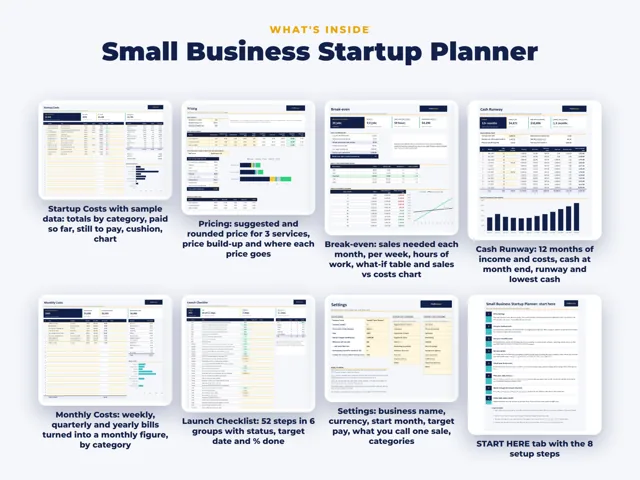
Small Business Startup Planner
Questions people ask
How much does it cost to start a mobile detailing business?
It depends on how much equipment you already own and whether you need your own water and power on site. A detailer who starts with a car, a small water tank and basic tools can begin for under a thousand dollars plus insurance. Our example budget below runs from about $850 to $5,700, but your costs will differ.
What equipment do I need to start a car detailing business?
The basics are a pressure washer or pump sprayer, a strong wet and dry vacuum, a dual action polisher with pads, microfiber towels, brushes and a set of safe chemicals. A mobile setup adds a water tank, hose reels and a power source. Start with what you need for your core packages and buy more as jobs come in.
Do I need a business license for mobile detailing?
Most places require some kind of general business license or registration, and some cities have extra rules for washing cars where the water reaches a storm drain. Rules change from place to place, so check with your city, county and state before your first paid job. The SBA page on licenses and permits explains which level of government handles what.
How do I start a car detailing business from home?
Many detailers run the business from home and drive to customers, so they do not need a shop. Keep your equipment and chemicals stored safely, check whether your city requires a home business permit, and ask any homeowners association about rules if clients will come to you. Track your mileage from the start, since driving is a big part of the job.
Is a mobile detailing business profitable?
It can be, because startup costs are modest and good detailers get repeat customers and referrals. Profit depends on pricing every package to cover your time, products, driving and taxes, and on keeping your service area tight. Record each job and expense so you can see your real profit each month.
Sources
- Launch your business: Apply for licenses and permits (U.S. Small Business Administration)
- Launch your business: Register your business (U.S. Small Business Administration)
- Plan your business: Calculate your startup costs (U.S. Small Business Administration)
- Stormwater Discharges from Municipal Sources (US EPA)
- Self-employment tax (Social Security and Medicare taxes) (IRS)
- Standard mileage rates (IRS)
General information, not tax, legal or financial advice. Check the rules for your state and your situation.