
To start a home daycare business, first find out what your state requires to care for children in your home, then complete the licensing steps, prepare your home for safety, set a weekly rate that covers your costs and pay, and find your first families through people you know. Licensing comes before anything else, because it decides how many children you can care for and what your home needs. After that, fair pricing and clean records keep the business going.
This guide walks you through each step in plain language, with an example budget, a worked pricing example and a 30-day launch plan.
1. Decide what kind of care you will offer
Before you look at rules, be clear about the program you want to run:
- Ages: infants and toddlers need more care and often have stricter rules than preschool or school-age children.
- Hours: full-time weekdays, part-time, before and after school, or evening and weekend care.
- Size: a small home program with a few children, or a larger group home with an assistant, if your state allows it.
- Approach: play-based, preschool readiness, or a focus on a language or outdoor play.
Start with the size you can safely handle on your own. You can grow once you know your routines and your state's rules.
2. Check state licensing and local requirements
Child care licensing is set by each state, so this step is the most important one. Childcare.gov explains that licensing is the main way child care is regulated in the U.S., that states and territories set the minimum health and safety rules programs must meet, and that licensed programs are monitored. Use the state and territory resources page on Childcare.gov to find your state and its child care contacts.
When you contact your state licensing office, ask:
- Do I need a license, registration or certification, or is my program size exempt?
- How many children of each age can I care for, and when do I need an assistant?
- What training is required, such as first aid, CPR or health and safety courses?
- What background checks are needed for me and other adults in the home?
- What will the home inspection look at, such as exits, smoke alarms, fencing and safe sleep?
Then check with your city and county. The SBA explains that most businesses need some mix of state and local licenses and permits, and some areas have zoning rules for home businesses. If you rent or live in a community with a homeowners association, check your lease or rules too.
Also register your business. Many providers start as a sole proprietor. If you use a business name, most states require a DBA ("doing business as") registration. Ask an insurance agent about liability coverage for home child care, since a regular homeowner's policy may not cover it.
3. Work out your startup costs
List every cost before you spend anything. The SBA suggests keeping one-time costs separate from monthly costs such as food, supplies and insurance.
Example budget, your costs will differ:
| Item | Low | High |
|---|---|---|
| Licensing fees, background checks and required training | $100 | $800 |
| Safety items (gates, outlet covers, smoke alarms, fire extinguisher, first aid kit) | $150 | $600 |
| Cribs, cots, high chairs, small tables and chairs | $300 | $2,000 |
| Toys, books and art supplies | $150 | $800 |
| Outdoor play area fixes or fencing | $0 | $2,500 |
| Insurance (first months) | $200 | $900 |
| Business registration | $0 | $300 |
| Marketing and simple website | $0 | $300 |
| Total | $900 | $8,200 |
Your state's inspection list may add items. Plug your own numbers into the free startup cost calculator to see your total and how long your savings will last while you fill spots.
4. Set your rates
Most home daycares charge a weekly rate per child, often with a higher rate for infants. Some offer part-time rates. Families usually pay ahead, and many providers charge for holding a spot during vacations.
Worked pricing example (example numbers only, full-time care for 6 children):
- Check first that your license allows 6 children of these ages.
- Your target pay: 55 hours a week (50 open hours plus prep and cleaning) at $25 an hour, so 55 x $25 = $1,375
- Food and snacks: $28 per child, so 6 x $28 = $168
- Supplies, crafts and cleaning products: $60
- Share of insurance, licensing and training: $45
- Extra utilities and wear on your home: $40
- Weekly cost before profit: $1,375 + $168 + $60 + $45 + $40 = $1,688
- Add 15% for taxes, sick days and empty spots: $1,688 x 1.15 = $1,941.20
- Per child: $1,941.20 / 6 = $323.53
- Round to a rate of $325 per child per week
If you only fill 4 spots at first, the same costs spread over fewer children, so plan your savings for that. The free price per job calculator can help you test different numbers. Compare your result with local rates, and put your rates, hours, late pickup fees and holiday policy in a written parent handbook.
5. Find your first families
Families choose child care on trust, so start close to home.
- People you know. Tell friends, neighbors, coworkers and family members with young children.
- Local parent groups. Post a short intro once you are licensed, with your ages, hours and area.
- Your state's child care search or referral service. Ask your licensing office whether your state lists licensed providers and how to be included.
- Places parents go. Libraries, pediatric offices, churches and community centers often have notice boards.
- A free business profile on map and search listings, with photos of your play space.
Offer short visits so parents can see your home and meet you. Ask happy families for referrals once they settle in.
6. Track your money and plan for taxes
Keep business money separate from personal money. A separate checking account makes tax time far easier.
Track these every week:
- Income from each family, and which payments are late
- Expenses such as food, supplies, toys, insurance, training and licensing
- Home costs such as rent or mortgage interest, utilities and repairs, kept separately so you can work out the business share
IRS Publication 587, Business Use of Your Home, has special rules for daycare providers. If you meet the licensing condition (you have applied for, been granted or are exempt from a state license or approval), you can deduct part of your home even when the same rooms are used for family life. The deduction is based on two percentages: how much of your home's space is used for daycare, and how many hours it is used for daycare compared with all hours. For example (example numbers only), if daycare uses 30% of your home's space and 25% of the hours in the year, you would multiply 30% x 25% = 7.5%, and that share of your indirect home costs may be deductible. Read the current publication on irs.gov for the exact rules and worksheets.
As a self-employed provider you also pay self-employment tax of 15.3% on net earnings (Social Security plus Medicare), on top of income tax, and you may need quarterly estimated payments. Our guide to small business tax deadlines for 2027 lists the dates, and the free self-employed tax calculator helps you estimate what to set aside. This is general information, not tax or legal advice.
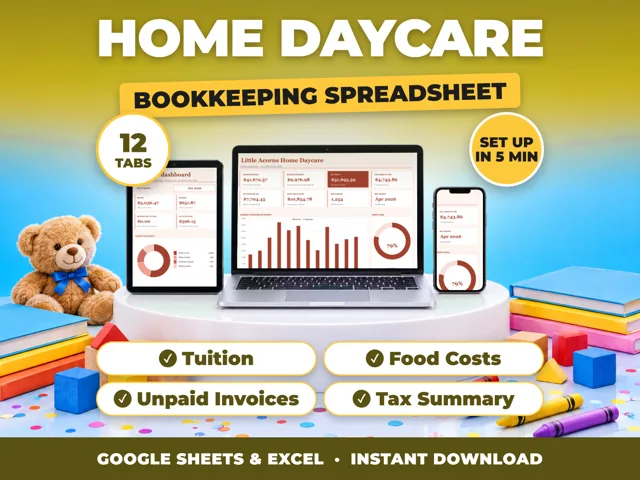
The home daycare bookkeeping spreadsheet has a START HERE tab, Settings, dashboards, Income, Expenses, Mileage, Unpaid Invoices, Top Clients, a Monthly Summary, Quarterly totals and a Tax Summary, in Excel and Google Sheets. It does not do attendance, invoicing or payroll, so keep those records separately. For a simple weekly habit, read how to track business expenses.
7. A simple 30-day launch plan
Licensing can take longer than 30 days in some states, so treat this as a plan to get ready and start the process.
Days 1 to 7: learn the rules - Contact your state licensing office and write down every requirement. - Check city, county, lease or homeowners association rules. - Sign up for any required training.
Days 8 to 14: prepare your home - Start your license application and background checks. - Make safety changes and buy required items. - Get insurance quotes and open a separate bank account.
Days 15 to 21: plan the business - Write your parent handbook with rates, hours and policies. - Plan a daily routine and simple menus. - Set up your bookkeeping spreadsheet.
Days 22 to 30: get ready to open - Prepare for the home inspection. - Tell people you know and collect names of interested families. - Enroll families only once your state says you may open.
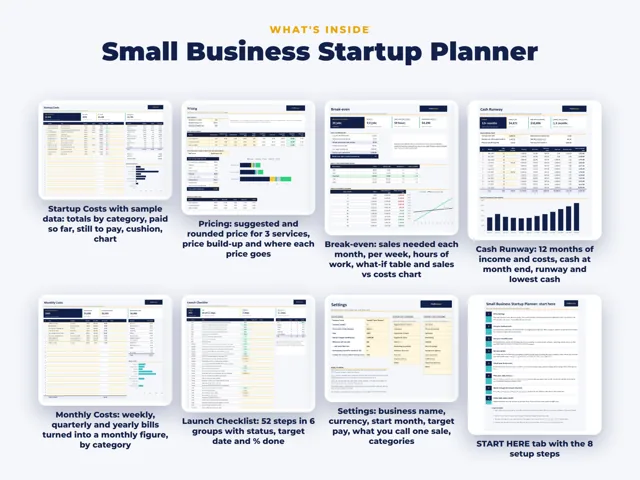
To plan startup costs, rates, break even and cash runway before you open, the coming-soon small business startup planner puts it in one workbook.
Common mistakes to avoid
- Opening before you are licensed or confirmed exempt. Check with your state first.
- Taking more children than allowed. Ratios protect children and your license.
- Underpricing to fill spots. Your rate has to cover long days, food and sick days.
- Mixing household and business spending. It makes the home deduction much harder.
- No written policies. A clear handbook prevents arguments about late pickup and holidays.
A home daycare business lets you earn from home while doing important work. Follow your state's rules, price your time fairly, and keep clean records so you always know where you stand.
Tools for this





Questions people ask
Do I need a license to start a home daycare business?
In most cases, yes. Childcare.gov explains that licensing is the main way child care is regulated, and each state and territory sets its own rules. Your state may also allow some small home programs to be license exempt, so check with your state child care licensing office before you care for any children.
How much does it cost to start a home daycare business?
It depends on what your home already has and what your state requires for safety and equipment. Licensing fees, background checks, safety items, furniture, toys and insurance are the usual costs. Our example budget below runs from about $900 to $8,200, but your costs will differ.
How much should I charge for home daycare?
Many providers set a weekly rate per child. Add up your weekly costs and the pay you want, add a margin for taxes and sick days, then divide by the number of children your license allows. Compare your result with local rates before you settle on a price.
Can I deduct part of my home for a home daycare business?
Possibly. IRS Publication 587 has special rules for daycare providers, so you can deduct part of your home even if you also use the space for personal purposes, as long as you meet the state licensing condition. The deduction uses a time and space percentage. Read the publication on irs.gov or ask a tax professional.
How do I start my own daycare business with no experience?
Start by learning your state's licensing rules, since your state may require training such as health and safety or first aid before you open. Some providers work in a center or another home daycare first to learn routines and parent communication. Start small with the number of children you can safely handle.
Sources
- How Is Child Care Regulated to Ensure Children's Health and Safety? (Childcare.gov)
- See State And Territory Resources (Childcare.gov)
- Publication 587 (2025), Business Use of Your Home (IRS)
- Launch your business: Apply for licenses and permits (U.S. Small Business Administration)
- Launch your business: Register your business (U.S. Small Business Administration)
- Plan your business: Calculate your startup costs (U.S. Small Business Administration)
- Self-employment tax (Social Security and Medicare taxes) (IRS)
General information, not tax, legal or financial advice. Check the rules for your state and your situation.