
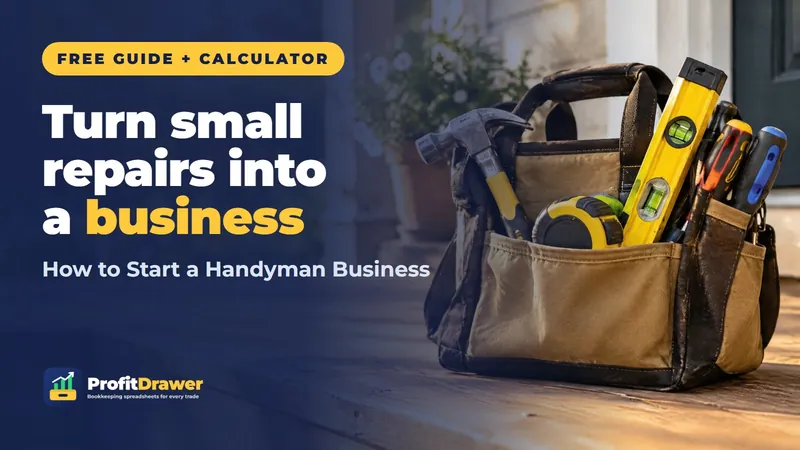
To start a handyman business, decide which small repair jobs you will offer, check what your city, county and state allow a handyman to do, register your business and get insurance, then set prices that cover your time, travel and materials. Your first customers will usually be neighbors, friends and their referrals. Many people start with tools they already own, so the main costs are insurance, a license and some marketing. The work that keeps you in business is pricing every job properly and tracking your money from the first day.
This guide walks you through each step, with an example budget, a worked pricing example and a 30-day launch plan.
1. Choose the handyman services you will offer
A handyman business does many small jobs that are too minor for a big contractor. Pick the ones you can do well and quickly:
- Small repairs: drywall patches, sticking doors, loose railings, caulking, squeaky floors.
- Installs and assembly: shelves, curtain rods, TV mounts, furniture, blinds, smoke alarms.
- Outdoor work: gutter cleaning, fence repair, pressure washing a deck, minor siding fixes.
- Move in and move out help: touch-up painting, picture hanging and small fixes for renters, landlords and real estate agents.
- Odd job lists: a half day or full day working through a homeowner's list.
Start with five to eight services you are confident in. It is better to say no to a job than to do it badly or unsafely. Add services as your skills grow.
2. Check local rules and register
This is the step to take seriously. Rules about what a handyman can do without a contractor or trade license differ a lot from place to place, so check with your city, county and state before you quote any job. The SBA explains that licenses and permits can come from the federal, state and local level, depending on your activity and location.
A simple checklist:
- Pick a business structure. Many handymen start as a sole proprietor. Some form an LLC to separate business and personal liability; a state filing fee applies.
- Register your business name. If you trade under a name other than your own, most states require a DBA ("doing business as") registration.
- Get a general business license from your city or county if they require one, and ask which jobs need a contractor or trade license.
- Get an EIN from the IRS if you will hire employees or form a partnership or corporation. It is free on irs.gov, so never pay a website for one.
- Get insurance. General liability insurance is the usual starting point, since you work in other people's homes. If you hire help, workers' compensation rules apply in most states.
- Know the lead paint rule. The EPA's Renovation, Repair and Painting rule covers paid work that disturbs painted surfaces in homes, child care facilities and preschools built before 1978. Anyone paid to do that work, including a sole proprietor, must follow lead-safe practices and be certified: EPA runs the program in most states, and some states and Tribes run their own EPA-authorized programs. Read the EPA page before you sand, scrape or cut into old paint.
3. Work out your startup costs
List every cost before you buy anything. The SBA suggests separating one-time costs, such as tools and licenses, from monthly costs, such as insurance, phone and fuel.
Example budget, your costs will differ:
| Item | Low | High |
|---|---|---|
| Hand and power tools you do not already own | $300 | $2,500 |
| Ladders and safety gear | $100 | $400 |
| Business registration and local license | $50 | $500 |
| General liability insurance (first months) | $100 | $800 |
| Vehicle setup (racks, bins, organizers) | $0 | $600 |
| Simple website or booking page, business cards | $0 | $400 |
| Marketing (flyers, door hangers, local ads) | $50 | $500 |
| Phone and software for the first months | $50 | $150 |
| Total | $650 | $5,850 |
Put your own numbers into the free startup cost calculator to see your total and how long your savings will last.
4. Set your prices
Handymen usually charge by the hour, by the job (a flat rate) or with a minimum charge for small visits. Flat rates work well for common jobs, like mounting a TV, because customers like to know the price up front. Whatever you choose, charge for materials on top and set a minimum so short trips still pay.
Worked pricing example (example numbers only):
- Job: replace a bathroom faucet and fix a sticking door, about 2 hours
- Your target pay: $45 an hour, so 2 x $45 = $90
- Materials you buy for the job: $25. Add 10% for your time to shop: $25 x 1.10 = $27.50
- Driving: 16 miles round trip. Using $0.70 a mile as a rough running cost, 16 x $0.70 = $11.20
- Share of insurance, phone and marketing: about $12 per job
- Cost before profit: $90 + $27.50 + $11.20 + $12 = $140.70
- Add a 20% markup for taxes and slow weeks: $140.70 x 1.20 = $168.84
- Round to a price of $170 for the job
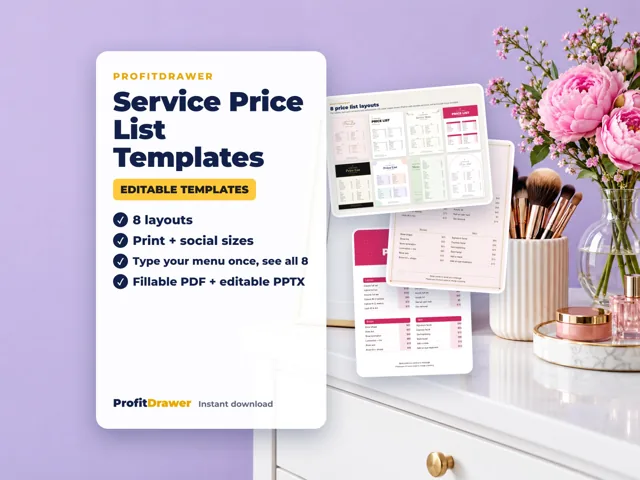
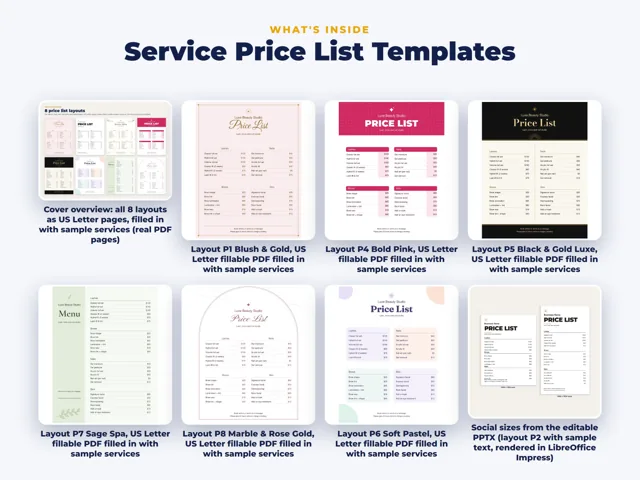
The free price per job calculator does this arithmetic for you. Check what other local handymen advertise so your rates sit in a sensible range. Then put your common jobs and your minimum charge on one clear page. The service price list templates give you 8 layouts as a fillable PDF, editable slides and blank images sized for social posts.
5. Get your first customers
Your first ten jobs will most likely come from people who know you or live near you.
- Tell everyone you know. Friends, family, coworkers and neighbors. Ask each one to pass your name on.
- Neighborhood groups and community boards. Post a short intro, a photo of your work and your service area.
- Door hangers in streets close to home, so travel time stays low.
- A free business profile on map and search listings with photos and your list of services.
- Landlords, property managers and real estate agents often need fast, small repairs between tenants or before a sale.
- Before and after photos of every job. They sell the next job better than any ad.
Ask happy customers for a short review the same day you finish, while they are pleased with the result.
6. Track your money and plan for taxes
From the first job, keep business money apart from personal money. A separate checking account makes tax time far easier.
Track these every week:
- Income from each job, and which invoices are still unpaid
- Expenses such as tools, materials, insurance, phone and advertising
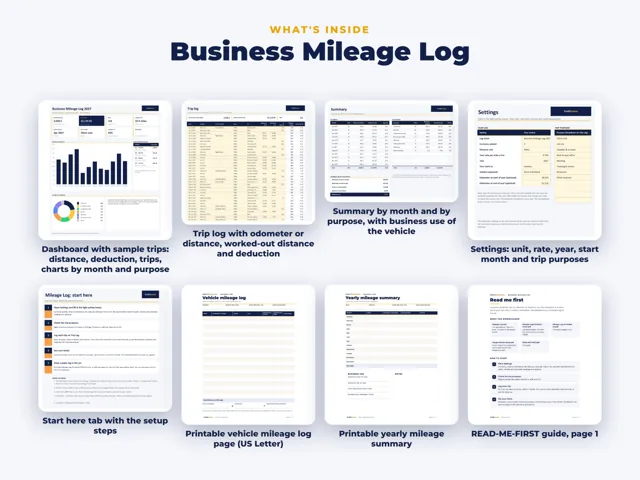
- Mileage for driving to jobs and to the hardware store. The IRS business standard mileage rate for 2026 was 72.5 cents a mile from January to June and 76 cents a mile from July to December. Check the 2027 rate on irs.gov before you file. A mileage log with a printable car log makes this a two-minute habit.
As a self-employed handyman you pay self-employment tax of 15.3% (12.4% Social Security plus 2.9% Medicare) once your net earnings reach $400, on top of income tax. If you expect to owe $1,000 or more for the year, the IRS says you generally need to make estimated tax payments. See our guide to small business tax deadlines for 2027 and the free self-employed tax calculator. This is general information, not tax or legal advice.
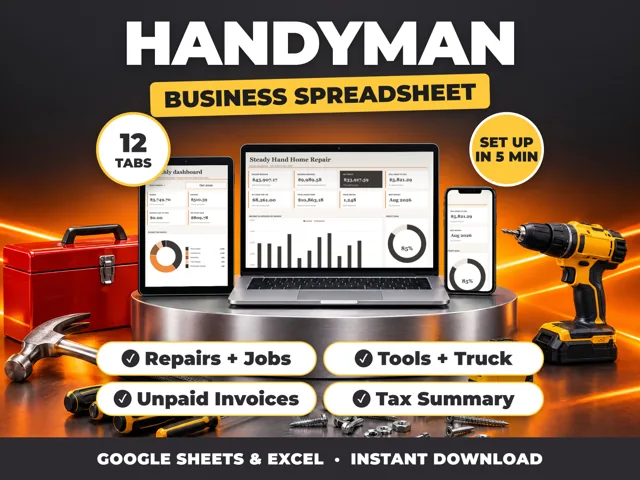
A spreadsheet is enough at the start. The handyman business spreadsheet has a START HERE tab, Settings, dashboards, Income, Expenses, Mileage, Unpaid Invoices, Top Clients, a Monthly Summary, Quarterly totals and a Tax Summary, in Excel and Google Sheets. For tips on the habit itself, read how to track business expenses.
7. A simple 30-day launch plan
Days 1 to 7: decide and register - Write your list of services and your service area. - Call or check the websites of your city, county and state about licenses and job limits. - Choose a name, register it if needed and apply for a local license. Get insurance quotes. - Open a separate bank account.
Days 8 to 14: set up - Sort your tools, buy what is missing and set up your vehicle so tools are easy to find. - Time yourself on common jobs so your prices are based on real hours. - Write your price list with a minimum charge. - Set up your bookkeeping spreadsheet and mileage log.
Days 15 to 21: tell people - Post in local groups, hand out door hangers and set up a free business listing. - Message 20 people you know and ask for referrals. - Contact three landlords or property managers in your area.
Days 22 to 30: work, learn and adjust - Do your first paid jobs. Write down how long each one really took. - Raise or adjust prices on jobs that took longer than planned. - Ask for reviews and photos. - At the end of the month, check income, expenses and profit.
Common mistakes to avoid
- Taking jobs that need a license you do not have. Check first, every time you are unsure.
- No minimum charge. A 20-minute job across town can lose you money.
- Forgetting materials and shopping time. Charge for both.
- Mixing personal and business spending. It hides your real profit and makes taxes harder.
- Not saving for taxes. Put a share of every payment aside for quarterly payments.
A handyman business can start small and grow on referrals. Stay within the rules where you live, price each job on real numbers and keep clean records, and you will always know how your business is doing.
Tools for this





Questions people ask
How much does it cost to start a handyman business?
It depends on how many tools you already own and whether your vehicle is ready for work. Someone with a decent tool set and a pickup or van can start with a few hundred dollars for registration, insurance and marketing. Our example budget below runs from about $650 to $5,850, but your costs will differ, so add up your own list in the free startup cost calculator.
Do I need a license to start a handyman business?
Most places want at least a general business license, and many have rules about which jobs a handyman can take without a contractor or trade license. Those rules differ a lot by location, so check with your city, county and state before you quote any job. The SBA page on licenses and permits explains which level of government handles what.
Do I need an LLC for a handyman business?
No. Many handymen start as sole proprietors under their own name. An LLC can separate business and personal liability, but it comes with a state filing fee and sometimes yearly reports. Compare the cost in your state and ask a local professional if you are unsure.
How do I start a handyman business with no experience?
Start with small, low-risk jobs you can do well, such as hanging shelves, assembling furniture, patching drywall and replacing fixtures that need no permit. Practice on your own home and on jobs for friends, time yourself, and add new skills one at a time. Turn down work you are not sure you can do safely and correctly.
What do I need to start a handyman business?
You need a solid tool set, a reliable vehicle, any business license your area requires, general liability insurance, a clear price list and a simple way to track income, expenses and miles. A separate bank account for the business makes records and taxes much easier.
Sources
- Launch your business: Apply for licenses and permits (U.S. Small Business Administration)
- Launch your business: Register your business (U.S. Small Business Administration)
- Plan your business: Calculate your startup costs (U.S. Small Business Administration)
- Get an employer identification number (IRS)
- Self-employment tax (Social Security and Medicare taxes) (IRS)
- Estimated taxes (IRS)
- Standard mileage rates (IRS)
- Lead Renovation, Repair and Painting Program (EPA)
General information, not tax, legal or financial advice. Check the rules for your state and your situation.