
To start a dog walking business, choose the walks and area you will serve, check your city and county rules, and get pet care liability insurance before your first client. Then set a price per walk from your time and travel, meet clients for a free meet and greet, and keep a simple record of every walk, payment and mile from day one.
Dog walking needs very little money to start, and you can begin in your own neighborhood. What makes it a real business is reliability, safety and good records. Here is a step by step plan.
Step 1: Choose your services and your area
Keep the first menu simple so you can quote quickly:
- Solo walks: 30 or 60 minutes, one dog or dogs from the same home.
- Small group walks: a few friendly dogs walked together, if your local rules allow it.
- Puppy visits: short midday visits for potty breaks, feeding and play.
- Pet sitting drop ins: feeding, litter, meds and a short walk while owners travel.
- Add ons: extra dogs, weekend or holiday walks, a wipe down after muddy walks, key pickup.
Then draw your service area. A tight area (a few neighborhoods or apartment complexes) means less driving between walks, more walks per day and lower costs. Many walkers start with every home they can reach on foot.
Step 2: Check local rules, insurance and safety
There is no single national dog walking license. The SBA explains that licenses depend on your business activity and location (SBA licenses and permits). Check with your city, county and state for:
- A general business license or business tax registration.
- Local rules for commercial dog walkers, such as permits for parks or a limit on dogs per walker.
- Leash laws and pickup rules in the areas you will walk.
Register a business name or LLC if you want one; the SBA's register your business page explains the options. An EIN is free from the IRS (EIN page). Open a separate bank account for walk payments.
Get pet care liability insurance, and ask about care, custody and control coverage (for injuries to a pet in your care) and bonding (for lost keys or theft claims). Clients often ask whether you are insured before they hand over a key.
Write a short client agreement and pet profile for every dog: vet contact, emergency contact, feeding and meds, behavior notes, how keys or door codes are handled, cancellation policy and permission to get emergency vet care. Learn basic pet first aid and carry a small kit.
Step 3: Startup costs
This is an example budget for a solo dog walker. Your costs will differ by city and insurer.
| Item | Low | High |
|---|---|---|
| Pet care liability insurance and bonding (first year) | $150 | $600 |
| Business license and registration | $25 | $300 |
| Leashes, harnesses, waste bags, treats, towels | $40 | $150 |
| Pet first aid kit and class | $30 | $150 |
| Lockbox or key tags | $0 | $60 |
| Rain gear and good walking shoes | $0 | $150 |
| Business cards, flyers and door hangers | $30 | $120 |
| Simple website and booking page (first year) | $0 | $100 |
| Total | $275 | $1,630 |
Add your own numbers to the free startup cost calculator to see how many walks cover your setup costs.
Step 4: Price each walk with real arithmetic
A 30 minute walk takes more than 30 minutes once you count travel, entering the home, getting the dog ready and writing an update for the owner. Here is a worked example:
- Time: 30 minute walk + 10 minutes travel + 5 minutes in and out and update = 45 minutes, or 0.75 hour.
- Target pay: $24 an hour, so 0.75 x $24 = $18.00.
- Mileage: 2 miles x $0.725 = $1.45.
- Overhead share (insurance, license, supplies and marketing, about $1,000 a year spread over 1,000 walks): $1,000 / 1,000 = $1.00.
- Cost before profit: $18.00 + $1.45 + $1.00 = $20.45.
- Add 15% profit: $20.45 x 1.15 = $23.52, so round to $24 per walk.
The mileage figure uses the IRS 2026 business rate of 72.5 cents per mile for January to June; the IRS raised it to 76 cents per mile for July to December 2026 (IRS standard mileage rates). Check the 2027 rate on irs.gov when it is announced. Try your own time and rates in the free price per job calculator.
Price extras on top: for example $8 for each extra dog, $5 more for weekends and a higher holiday rate. Offer a weekly package (for example 5 walks paid in advance) to keep your schedule steady, and look at what other walkers in your area charge before you publish your price list.
Step 5: Get your first clients
- Start next door. Tell neighbors, friends and coworkers you are taking clients, and ask them to share.
- Leave flyers or door hangers in your service area with a simple price list and how to book.
- Talk to local pet businesses. Groomers, pet supply stores and some vets keep a referral list or a bulletin board.
- Post in neighborhood groups with a friendly photo and a clear offer, such as a free meet and greet.
- Set up a free map listing and ask every happy client for a review.
- Send a photo update after every walk. It is the cheapest marketing there is, and owners share it.
Always do a meet and greet before the first walk. Meet the dog with the owner, check the leash and harness, practice the door routine, and sign the agreement.
Step 6: Track money and taxes from day one
Dog walking payments are small and frequent, which makes them easy to lose track of. Record every walk paid, every supply bought and every business mile you drive. The IRS recordkeeping page says any system that clearly shows income and expenses can work.
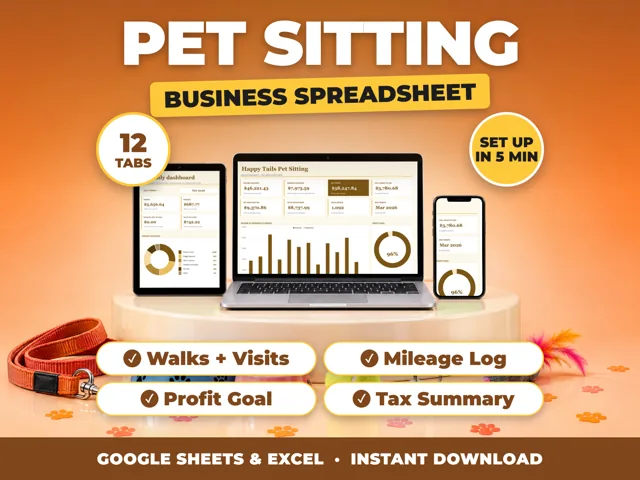
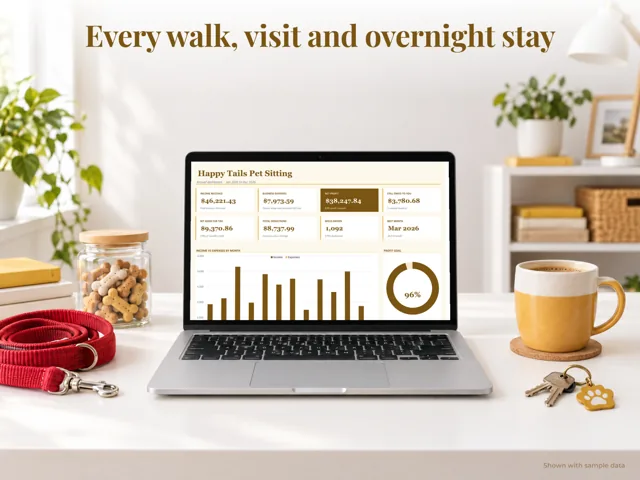
A spreadsheet like the pet sitting business spreadsheet, set up for pet sitters and dog walkers, gives you Income, Expenses, Mileage and Unpaid Invoices tabs, a dashboard, Top Clients, a Monthly Summary and a Quarterly and Tax Summary, in Excel or Google Sheets. It does not do scheduling or booking. Our guide on how to track business expenses has an easy weekly routine.
As a self-employed dog walker you generally owe self-employment tax of 15.3% on net earnings of $400 or more (IRS self-employment tax), plus income tax. If you expect to owe $1,000 or more for the year, the IRS generally expects quarterly estimated payments (IRS estimated taxes). See the 2027 small business tax deadlines, and use the free self-employed tax calculator to estimate what to set aside from each week's walks. This is general information, not tax advice.
A simple 30 day launch plan
Week 1: Decide and check. Choose your services and service area. Check city and county license rules and park rules. Get insurance quotes.
Week 2: Set up. Register the business if needed, get an EIN, open a bank account, buy insurance and supplies, write your client agreement and pet profile form.
Week 3: Price and announce. Work out your price per walk with the math above. Print flyers, set up your map listing and post in neighborhood groups. Book meet and greets.
Week 4: Walk and record. Do your first paid walks, send a photo update after each one, ask for reviews, and log every walk, payment and mile. Move a share of each payment to a tax savings account.
If you want to plan costs and break even before you start, the small business startup planner puts it all in one workbook.
Tools for this





Questions people ask
How much does it cost to start a dog walking business?
Dog walking is one of the cheapest businesses to start. If you already have a phone and good walking shoes, the main costs are insurance, a business license, leashes and supplies, and simple marketing. The example budget in this guide runs from about $275 to $1,630.
How much should I charge for a dog walk?
Work it out from your time, travel and costs, then compare with local walkers. In the worked example in this guide, a 30 minute walk including travel and a share of insurance and supplies comes out at about $24. Prices for longer walks, extra dogs and weekends are usually added on top.
Do I need a license to start a dog walking business?
It depends on your city, county and state. Many places require a general business license, and some cities have extra rules for commercial dog walkers, such as limits on how many dogs you walk at once in parks. Check your city and county websites before you take paying clients.
How can a kid start a dog walking business?
Kids usually start with neighbors their family already knows, with a parent's permission and help. Start with one calm dog at a time, agree on a simple price and schedule, keep a notebook of walks and money, and have a parent handle anything to do with keys, contracts or insurance.
How much can a dog walking business make a month?
It depends on how many walks you do each day and what you charge. For example, 10 walks a day at $24, 5 days a week, is about $1,200 a week, or roughly $5,200 a month over 4.33 weeks, before insurance, mileage, supplies and taxes. This is an example, not an average.
Sources
General information, not tax, legal or financial advice. Check the rules for your state and your situation.