
To start a credit repair business, first read the federal rules on credit repair from the FTC and CFPB, then check your state's rules and have a lawyer review your contract, disclosures and billing before you take a single client. After that, register your business, set up secure ways to handle client data, set a price you collect only after the work is done, and find clients through honest education, not promises. Credit repair is a regulated field with a history of scams, so doing it by the rules is the whole business. Never promise a score change or the removal of accurate information.
This guide walks you through each step, with an example budget, a worked pricing example and a 30-day launch plan. It is general information, not legal advice.
1. Understand what credit repair can and cannot do
A legitimate credit repair service helps people read their credit reports, find information that looks wrong, and dispute it with the credit bureaus and the businesses that reported it. It often includes education on budgeting and building credit over time.
What it cannot do matters just as much. The FTC's consumer page on fixing credit says credit repair companies cannot remove accurate, current negative information, and that most negative items age off a report after a set time. It also says anything a credit repair company can legally do, people can usually do themselves for little or no cost. The CFPB likewise tells consumers they can dispute errors on their own for free.
So your value is time, organization and education, not magic. Build your service and your marketing around that.
2. Read the federal rules: FTC, CROA and CFPB
The federal law is the Credit Repair Organizations Act (CROA). The FTC's page on the Act describes it this way:
- It bans untrue or misleading statements when offering or selling credit repair services.
- It requires certain disclosures up front.
- It bars credit repair companies from collecting payment before they perform the services.
- It requires contracts to be in writing.
- It gives consumers the right to cancel.
The FTC's consumer page adds what a credit repair contract should spell out, including the services to be performed, the right to cancel within three days at no charge, how long results will take, the total cost and any guarantees.
The CFPB's page on spotting credit repair scams lists warning signs for consumers. Among them: asking for payment up front, guaranteeing a specific score increase, advising people to dispute accurate information, and telling people not to contact the credit bureaus. Read these pages as a list of things your business must never do.
3. Check state rules and talk to a lawyer
Do you need a license to start a credit repair business? That depends on your state. Many states have their own credit repair or credit services laws on top of the federal Act, and these can include registration, a bond, extra disclosures or limits on fees. Rules in Texas, Florida, California and every other state can differ, so do not rely on a summary you read online.
Your checklist:
- Talk to a lawyer licensed in your state about federal and state credit repair rules, your contract and your billing.
- Contact your state attorney general's office or consumer protection office and your secretary of state about any registration or bond.
- Register your business with your state, or a DBA with your county, and ask your city or county about a business license. The SBA explains how state and local licenses depend on activity and location.
- Get a free EIN from the IRS if you will hire or form a partnership or corporation.
- Plan data security. You will handle very sensitive personal and financial information. Ask your lawyer which privacy and data protection rules apply, and use locked storage and strong passwords from day one.
- Get insurance. Ask about professional liability (errors and omissions) coverage.
4. Work out your startup costs
The SBA suggests listing one-time costs apart from monthly costs.
Example budget, your costs will differ:
| Item | Low | High |
|---|---|---|
| Business registration and local license | $50 | $500 |
| State registration or bond, if your state requires one | $0 | $2,000 |
| Lawyer review of contract, disclosures and billing | $500 | $2,500 |
| Professional liability insurance (first months) | $300 | $1,500 |
| Computer, printer and secure file storage | $200 | $1,200 |
| Simple website and marketing | $100 | $1,000 |
| Cash buffer for the first months | $500 | $2,000 |
| Total | $1,650 | $10,700 |
Do not skip the lawyer line to save money. In this field it is the most important cost on the list. Add your own quotes in the free startup cost calculator.
5. Price your service (and when you can charge)
Because the federal Act bars collecting payment before services are performed, your pricing and billing must be built around work you have already done. Many businesses describe a set of services for each period and bill after that work is complete. Have your lawyer confirm your exact billing setup fits federal and state law.
Worked pricing example (example numbers only):
- Your time per client each month (reviewing reports, preparing disputes, answering questions): 3 hours
- Your target pay: $35 an hour, so 3 x $35 = $105
- Postage and mailing costs: $12
- Share of insurance, legal review and phone: $15
- Cost before profit: $105 + $12 + $15 = $132
- Add a 20% markup for taxes and slow months: $132 x 1.20 = $158.40
- Round to $160 per client per month, billed after that month's work is done
To see what that means: 15 clients x $160 = $2,400 a month in sales before expenses and taxes. The free price per job calculator helps you test other numbers. Never tie your fee to a promised score change.
6. Find your first clients honestly
- Teach first. Free workshops at libraries, community groups or workplaces on reading a credit report.
- Partner with local professionals such as real estate agents, loan officers and housing counselors, without paying or taking referral fees your lawyer has not cleared.
- A free business listing on map and search results, with plain language about what you do.
- Clear, honest marketing. Explain that people can dispute errors themselves for free, and that you offer time, organization and guidance. No guarantees.
Honesty is also good business. Clients who know what to expect are less likely to cancel or complain.
7. Track your money and plan for taxes
Keep a separate business bank account. Each week, record income by client, which invoices are unpaid, and every expense, such as postage, insurance, legal fees and software.
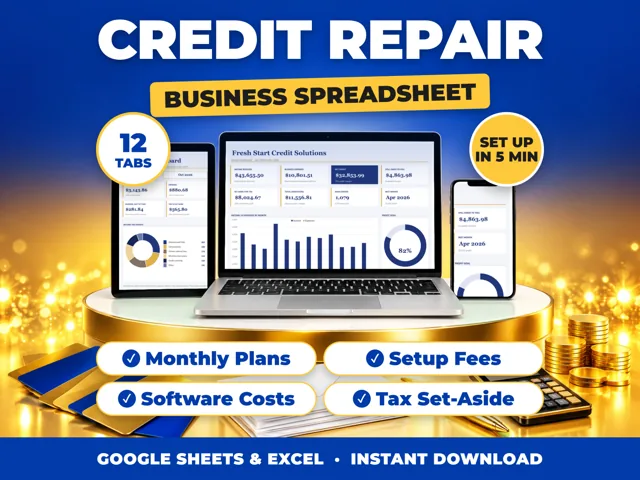
The credit repair business spreadsheet has a START HERE tab, Settings, dashboards, Income, Expenses, Mileage, Unpaid Invoices, Top Clients, a Monthly Summary, Quarterly totals and a Tax Summary, in Excel and Google Sheets. It does not send invoices or store client credit files, so keep those in secure, separate systems. For a simple weekly habit, read how to track business expenses.
As a self-employed owner you pay self-employment tax of 15.3% on net earnings, plus income tax. The IRS says you generally make estimated tax payments if you expect to owe $1,000 or more when you file. See small business tax deadlines for 2027 and estimate your set-aside with the free self-employed tax calculator. This is general information, not tax or legal advice.
8. A simple 30-day launch plan
Days 1 to 7: learn the rules - Read the FTC and CFPB pages linked in this guide. - Book a lawyer and contact your state attorney general's office. - Choose a business name and structure.
Days 8 to 14: set up - Register the business and complete any state registration or bond. - Get your contract, disclosures and billing reviewed. - Set up secure storage and a business bank account.
Days 15 to 21: plan numbers and outreach - Set your monthly price and your service list. - Book two free workshops and contact five local professionals. - Set up your bookkeeping spreadsheet.
Days 22 to 30: first clients - Sign your first clients with the reviewed contract. - Bill only after the work for each period is done. - Review your income and expenses at the end of the month.
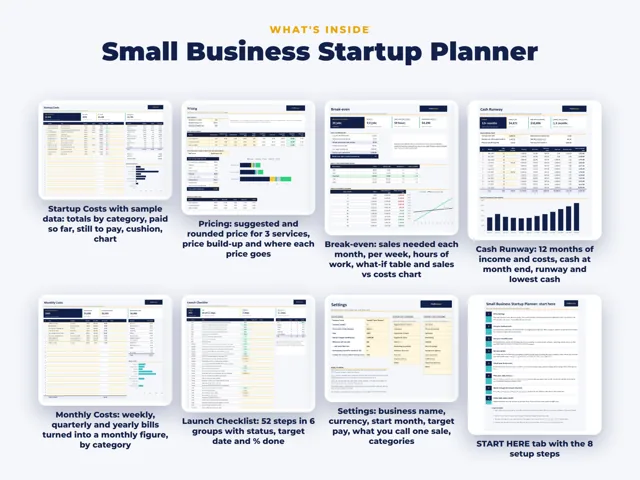
The coming-soon small business startup planner helps you lay out startup costs, pricing, break-even and cash runway before you spend money.
Common mistakes to avoid
- Charging up front. The FTC and CFPB both flag this.
- Promising results. No score guarantees, ever.
- Skipping state rules. Federal law is only the starting point.
- Weak data security. Client information must be protected.
- Disputing accurate information. The CFPB lists this as a scam warning sign.
Build the business on the rules, honest marketing and careful records, and you will have a service clients can trust.
Tools for this





Questions people ask
Do you need a license to start a credit repair business?
Federal law, the Credit Repair Organizations Act, sets rules for how credit repair services are sold, paid for and contracted. Many states add their own rules, which can include registration or a bond. Check with your state attorney general's office and secretary of state, and talk to a lawyer before you take your first client.
How do I start a credit repair business from home?
Many owners start from a home office with a computer, a phone and secure storage for client files. Register the business, have a lawyer review your contract and disclosures, check your state's rules, and set up billing that does not collect payment before the work is done. Protect client data carefully, since you will handle very personal information.
Is starting a credit repair business worth it?
It can be a low cost business to start, but it is heavily regulated and the FTC and CFPB warn consumers about scams in this field. It is only worth it if you follow the rules, never promise results, and are happy to bill only after work is done. Plan your numbers first so you know how many clients you need.
Can a credit repair company remove negative items?
The FTC says credit repair companies cannot remove accurate, current negative information from a credit report. What a legitimate service can do is help people find and dispute errors. The FTC and CFPB also point out that people can dispute errors themselves for free.
How do I start a credit repair business in Texas, Florida or California?
Start with the same federal rules that apply everywhere, then check your own state's rules, which can differ a lot. Contact your state attorney general's office or consumer protection office and your secretary of state, and have a lawyer licensed in your state review your setup. Do not rely on summaries of state law from blogs.
Sources
- Credit Repair Organizations Act (Federal Trade Commission)
- Fixing Your Credit FAQs (FTC Consumer Advice)
- How can I tell a credit repair scam from a reputable credit counselor? (CFPB)
- Launch your business: Apply for licenses and permits (U.S. Small Business Administration)
- Plan your business: Calculate your startup costs (U.S. Small Business Administration)
- Get an employer identification number (IRS)
- Self-employment tax (Social Security and Medicare taxes) (IRS)
- Estimated taxes (IRS)
General information, not tax, legal or financial advice. Check the rules for your state and your situation.