
To start a candle business, pick one candle type and a few scents, test them until they burn safely and evenly, and add clear warning labels. Then check local license, home business and sales tax rules, price each candle from its real cost, and sell first to people you know, at local markets or in an Etsy shop. Read the CPSC candle guidance before your first sale. Track every batch, sale and expense from the start so you know which candles make money.
This guide walks you through each step, with an example budget, a worked pricing example and a 30-day launch plan.
1. Choose your candle type and niche
Start with one product you can make the same way every time. Common starting points:
- Container candles: wax poured into a jar or tin. The easiest to start and the most popular.
- Pillar and molded candles: free-standing shapes. Need molds and a harder wax.
- Wax melts: no wick, simple to make, good as a lower-priced add-on.
- Specialty candles: wooden wicks, decorative shapes or seasonal collections.
Then pick a theme that makes you stand out: a local place, a mood, a season, a book or a gift occasion. Two or three scents in one jar size is enough to launch.
2. Make safety and testing part of the process
Candles are an open flame in someone's home, so testing is the most important step. Burn every new combination of wax, wick, fragrance load and container before you sell it. Watch the flame height, how the wax melts across the top, soot, and how hot the container gets. Write down what you test and the result. Change one thing at a time.
What the CPSC says applies to candles:
- Lead in metal-cored wicks. Candles and wicks with a metal core must not contain more than 0.06% lead by weight in that core. Makers and importers of metal-cored wick candles must issue a General Certificate of Compliance. The CPSC notes there is no certification requirement for wicks without a metal core.
- Hazardous substances. If a candle contains a substance that counts as hazardous under the Federal Hazardous Substances Act, it needs cautionary labeling.
- Voluntary standards. The CPSC lists ASTM standards for candle fire safety labeling (F2058), fire safety for candles (F2417) and glass candle containers (F2179), among others. They are voluntary, but they are a good guide to labels and testing.
The CPSC page also lists a Small Business Ombudsman you can contact with questions. Read the full page rather than relying on a summary, since rules can change.
3. Check local requirements and register
Every location sets its own business rules, so check with your city, county and state before you sell. The SBA explains that most businesses need a mix of state and local licenses and permits based on their activity and location.
- Pick a business structure. Many makers start as a sole proprietor. The SBA says you do not need to register if you trade under your own legal name, but most states require a DBA if you use a different one.
- Get a general business license if your city or county requires one.
- Ask about home business rules. Some areas have zoning or home occupation permits.
- Ask about sales tax. Your state revenue department can tell you whether you need a seller's permit for markets, online and wholesale sales.
- Get product liability insurance. Shops and markets often ask for proof before they stock your candles.
4. Work out your startup costs
List one-time and monthly costs separately, as the SBA suggests.
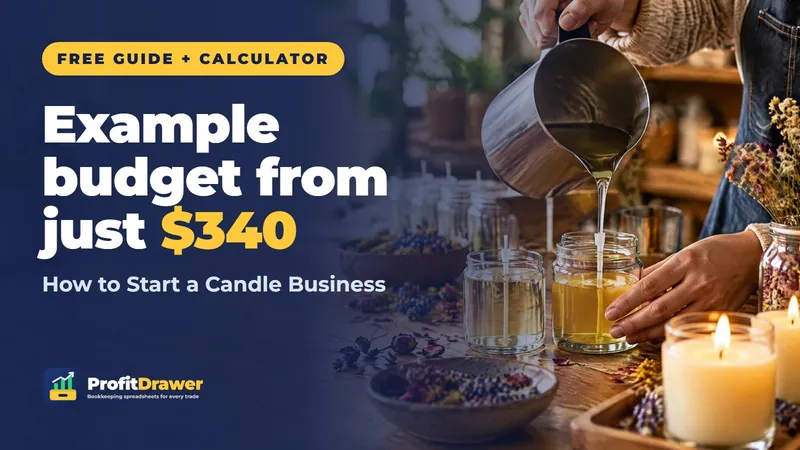
Example budget, your costs will differ:
| Item | Low | High |
|---|---|---|
| Wax, wicks and fragrance oils | $100 | $400 |
| Jars, tins and lids | $60 | $300 |
| Pouring pitcher, thermometer, scale, heat source | $40 | $200 |
| Labels with warnings | $20 | $150 |
| Test candles and samples | $30 | $150 |
| Boxes and shipping supplies | $40 | $200 |
| Business registration and local license | $50 | $300 |
| Product liability insurance (first months) | $0 | $500 |
| Marketing and photos | $0 | $300 |
| Total | $340 | $2,500 |
Use the free startup cost calculator with your own numbers.
5. Price each candle
Work out the cost of one candle from a full batch, then add your margin and fees.
Worked pricing example, one 8 oz container candle (example numbers only):
- Wax: $1.10
- Fragrance oil: $1.20
- Wick: $0.15
- Jar and lid: $1.60
- Label: $0.25
- Box and packing: $0.70
- Materials total: $1.10 + $1.20 + $0.15 + $1.60 + $0.25 + $0.70 = $5.00
- Your time: a batch of 24 takes 3 hours at $22 an hour, so 3 x $22 = $66, and $66 / 24 = $2.75 per candle
- Share of tools, testing and marketing: $0.75
- Cost per candle: $5.00 + $2.75 + $0.75 = $8.50
- Add a 40% markup: $8.50 x 1.40 = $11.90
- Cover an example 10% in selling and payment fees: $11.90 / 0.90 = $13.22 (rounded)
- Round to a price of $14, plus shipping
Check: $14 minus 10% fees ($1.40) is $12.60. Minus the $8.50 cost leaves $4.10 profit, on top of your $2.75 in pay.
If a shop buys wholesale, they will want a lower price so they can resell, so make sure your wholesale price still covers your full cost. The free price per job calculator helps you run the numbers.
6. Get your first customers
- Friends, family and coworkers. Ask for honest feedback on scent and burn.
- Local markets and holiday fairs. Candles are a popular gift, so plan around the gift seasons.
- An Etsy shop. Clear photos, the burn time you measured, the scent notes and the jar size help buyers choose.
- Local boutiques, salons and gift shops. Bring samples and a simple wholesale price sheet.
- Gift sets and custom orders. Weddings, showers and company gifts can bring larger orders.
7. Track your money and plan for taxes
Keep business money in a separate account. Each week, record sales by channel, every supply purchase and fee, and mileage for supply runs and markets. The IRS business standard mileage rate for 2026 was 72.5 cents a mile from January to June and 76 cents a mile from July to December. Check the 2027 rate on irs.gov before you file.
The IRS says materials that become part of the goods you sell, like wax, wicks and jars, go into cost of goods sold. If you are self-employed, you pay self-employment tax of 15.3% on net earnings of $400 or more, on top of income tax, and you generally make estimated payments four times a year if you expect to owe $1,000 or more. Use the free self-employed tax calculator to estimate what to set aside. This is general information, not tax or legal advice.
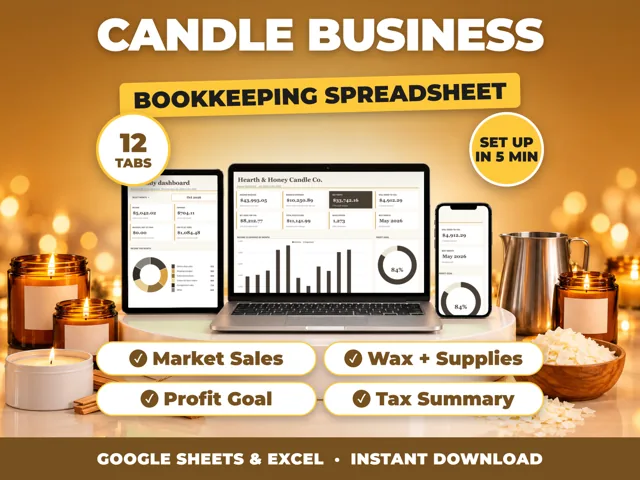
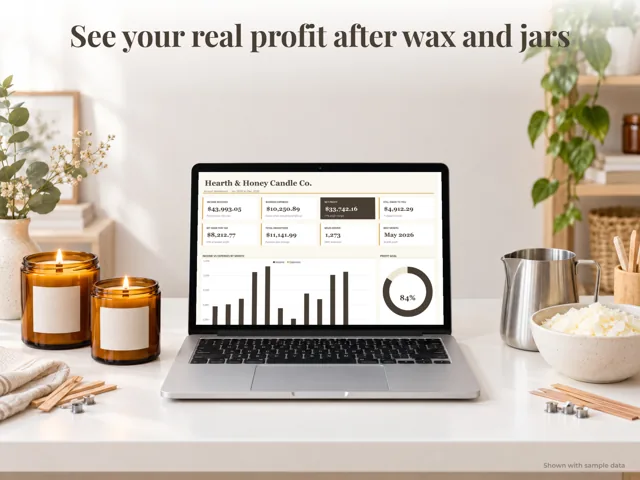
The candle business bookkeeping spreadsheet includes a START HERE tab, Settings, dashboards, Income, Expenses, Mileage, Unpaid Invoices, Top Clients, a Monthly Summary, Quarterly totals and a Tax Summary, in Excel and Google Sheets. It tracks money, not supplies on hand, so keep a separate batch and stock log. For tips on the weekly habit, see how to track business expenses.
8. A simple 30-day launch plan
Days 1 to 7: plan and register - Choose your candle type, jar and three scents. - Read the CPSC candle page. Check license, home business and sales tax rules. - Open a separate bank account. Order test supplies.
Days 8 to 14: test - Make test candles and burn them fully. Record every result. - Adjust wick size or fragrance load until each candle burns well. - Design labels with your warnings.
Days 15 to 21: produce and price - Make your first full batch. Time it. - Set prices from your real costs. Take photos. - Set up your bookkeeping spreadsheet.
Days 22 to 30: sell - Open your shop and book a local market. - Tell everyone you know and ask for reviews. - At month end, check sales, costs and profit per scent.
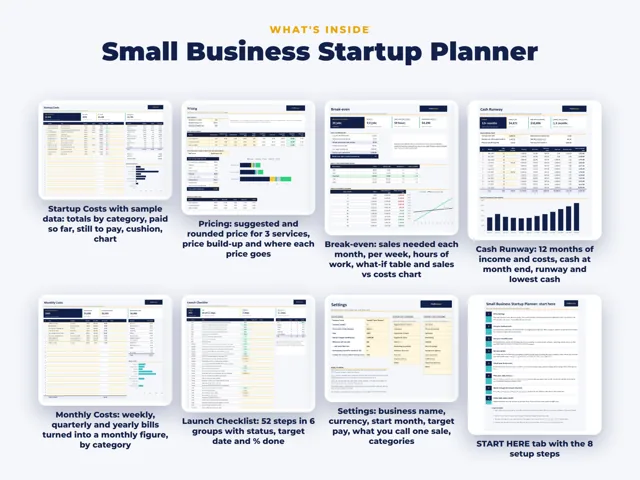
To plan costs, prices, break-even and cash runway in one workbook, the coming-soon small business startup planner also includes a 52-step launch checklist.
Common mistakes to avoid
- Selling before testing. One unsafe candle can end a business.
- Too many scents at once. It ties up cash in fragrance oils.
- Leaving out time and packaging. Price the whole candle, not just the wax.
- Missing warning labels. Tell buyers how to burn the candle safely.
- Not saving for taxes. Set aside part of each sale.
A candle business can start on a kitchen counter and grow one scent at a time. Test carefully, label clearly, price on real numbers and keep clean records.
Tools for this
Questions people ask
How much does it cost to start a candle business?
A small home candle business can start with a few hundred dollars of wax, wicks, fragrance, jars and basic tools. Our example budget below runs from about $340 to $2,500, but your costs will differ. Testing, packaging and insurance are the costs new makers most often leave out.
What do I need to start a candle business?
You need wax, wicks, fragrance, containers, a heat source, a pouring pitcher, a thermometer and a scale, plus labels with safety warnings. You also need any license your city, county and state require and a clear testing routine. Check the CPSC candle guidance before you sell.
How do I start a candle business with no money?
You cannot start with nothing, but you can start very small. Buy one wax type, one container size and two or three scents, test them well, and sell a small batch to people you know before you buy more. Reinvest the first profits into supplies.
Are there rules for selling candles?
Yes. The CPSC limits lead in metal-cored wicks to 0.06% by weight, and candles that contain a hazardous substance under the Federal Hazardous Substances Act need cautionary labeling. The CPSC also lists voluntary ASTM standards for candle fire safety and warning labels. Check with your city, county and state for local business rules too.
Can I make candles at home to sell?
Many makers start at home, but your city or county may have home business or zoning rules. Ask your local government office before you start, and keep a safe, clean work area away from open flames and children. Your insurance should cover the products you sell.
Sources
- Candles: business guidance (U.S. Consumer Product Safety Commission)
- Launch your business: Apply for licenses and permits (U.S. Small Business Administration)
- Launch your business: Register your business (U.S. Small Business Administration)
- Plan your business: Calculate your startup costs (U.S. Small Business Administration)
- Publication 334, Tax Guide for Small Business (IRS)
- Self-employment tax (Social Security and Medicare taxes) (IRS)
- Estimated taxes (IRS)
- Standard mileage rates (IRS)
General information, not tax, legal or financial advice. Check the rules for your state and your situation.