
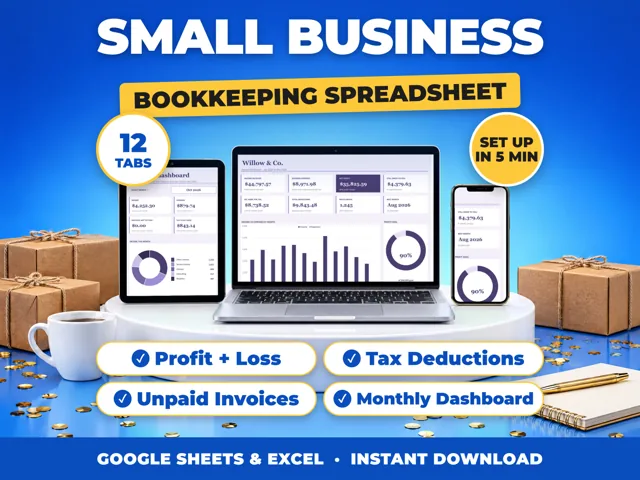
Revenue is all the money your business takes in from sales before anything is subtracted. Profit is what is left after you subtract your business expenses. If you invoice $60,000 in a year and spend $18,000 on supplies, fuel and fees, revenue is $60,000 and net profit is $42,000. On IRS Schedule C, revenue starts as gross receipts on line 1. A ProfitDrawer bookkeeping spreadsheet shows both, plus profit margin, for every month.
Terms you will see:
| Term | What it means |
|---|---|
| Revenue (gross receipts, sales) | Everything customers paid you |
| Gross profit | Revenue minus the direct cost of what you sold |
| Net profit | Revenue minus all business expenses |
| Profit margin | Net profit divided by revenue |
In the example above, the margin is $42,000 / $60,000 = 70%.
Why the difference matters:
- Taxes are figured on profit. Self-employment tax applies once net earnings from self-employment are $400 or more, so unrecorded expenses mean paying tax on money you never kept.
- Revenue can hide a loss. A busy month with high costs can still lose money.
- Profit is not cash. Money owed to you, owner draws and loan payments affect your bank balance without changing profit in the same way.
Record every business expense, not just the large ones, so the profit figure is real.
General information, not tax advice.
Source: Instructions for Schedule C (Form 1040) (2025) · Updated
Tools and spreadsheets for this


Related questions
- What is a profit and loss statement for a small business?
- How do I calculate profit margin for my small business?
- What is a good profit margin for a small business?
- How do I know if my small business is actually making money?
- What is the difference between cash and accrual accounting?
- How do I keep track of business expenses as a small business owner?
All questions on ProfitDrawer Answers →
General information, not tax, legal or financial advice. Check the rules for your state and your situation.