
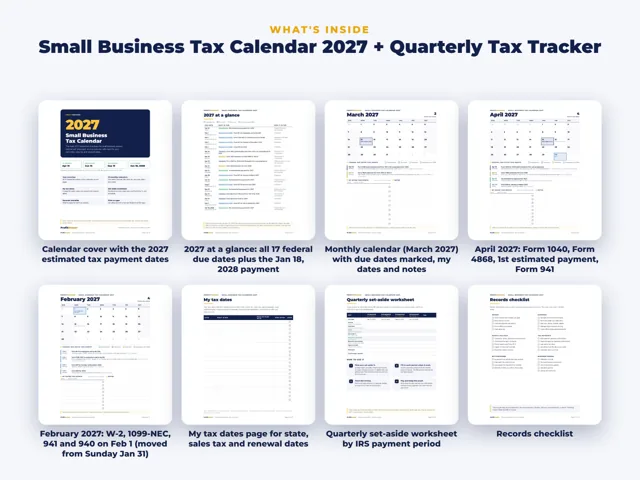
Form 941, Employer's Quarterly Federal Tax Return, reports federal income tax, Social Security tax and Medicare tax withheld from employees' pay, plus the employer's share of Social Security and Medicare tax. Any employer paying wages subject to these taxes files it every quarter. In 2027 it is due February 1 (for the last quarter of 2026), April 30, August 2 and November 1. ProfitDrawer's 2027 tax calendar lists these dates.
Who files and who does not (Instructions for Form 941, March 2026):
- After your first Form 941, you file every quarter even if you have no taxes to report, unless you filed a final return or an exception applies.
- If the IRS notified you to file Form 944, you file that once a year instead.
- Seasonal employers do not file for quarters with no wages and tell the IRS by checking line 18.
- Employers of household employees usually do not file it (see Schedule H), and farm wages go on Form 943.
- A single-member LLC with employees files using the LLC's own name and EIN.
- A sole proprietor with no employees pays no wages, so generally has nothing to report on Form 941; owners pay their own Social Security and Medicare through self-employment tax.
Not reported on Form 941: backup withholding and withholding on pensions or gambling winnings (Form 945), and federal unemployment tax (Form 940).
For 2026, Social Security tax is 6.2% each for employer and employee on wages up to $184,500, and Medicare tax is 1.45% each with no wage limit. General information, not tax advice.
Source: IRS Instructions for Form 941 (03/2026) · Updated
Tools and spreadsheets for this

Related questions
- When are small business taxes due in 2027?
- What is the Social Security wage base for 2026?
- Do I need to send a 1099-NEC to contractors I paid in 2026?
- What happens if a tax deadline falls on a weekend or holiday?
- How do I file business taxes for a single-member LLC?
- What is self-employment tax and how much is it in 2026?
All questions on ProfitDrawer Answers →
General information, not tax, legal or financial advice. Check the rules for your state and your situation.