
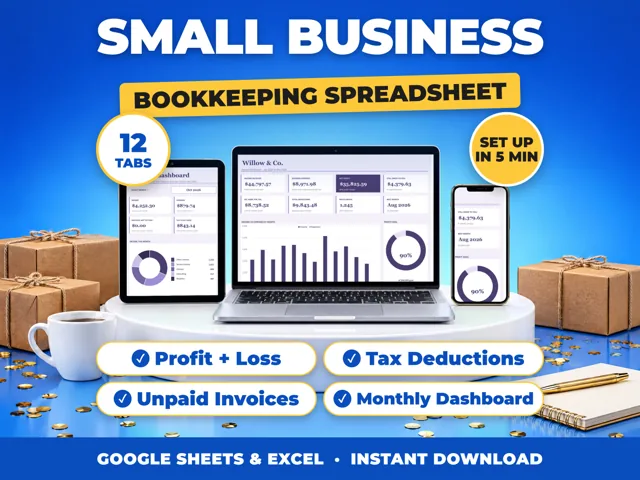
A bookkeeper records and categorizes income and expenses, reconciles bank and card accounts, tracks bills and unpaid invoices, and prepares reports such as the profit and loss and balance sheet. The Bureau of Labor Statistics says bookkeeping clerks often maintain some or all of an organization's general ledger. A bookkeeper keeps the books; a tax preparer files the return. Owners who keep their own books can use a ProfitDrawer bookkeeping spreadsheet, with room for 1,000 income rows a year, for the same income and expense records.
Typical monthly tasks:
- Enter or import transactions and assign each to the right account
- Reconcile bank, card and payment app accounts
- Record bills to pay (accounts payable) and invoices owed to you (accounts receivable)
- Send reminders on late invoices, if agreed
- Prepare a monthly profit and loss, and a balance sheet if needed
- Flag unusual items and questions for the owner
- Prepare year-end totals for the tax preparer
What a bookkeeper usually does not do: give tax advice or sign your return unless they are also a tax professional. The IRS requires anyone who prepares or helps prepare federal tax returns for pay to have a valid PTIN.
Bookkeeper, CPA or do it yourself? The SBA notes that a bookkeeper handles basic day-to-day tasks at a lower cost than a CPA, while a CPA has formal accounting education and offers more tailored service. Many small businesses do their own books during the year and pay an accountant at tax time.
Source: Bookkeeping, Accounting, and Auditing Clerks (U.S. Bureau of Labor Statistics) · Updated
Tools and spreadsheets for this



Related questions
- What is the difference between bookkeeping and accounting?
- How much does it cost to hire a bookkeeper for a small business?
- How do I do bookkeeping for a small business myself?
- What should I give my accountant at the end of the year?
- What is a general ledger in simple terms?
- How much does it cost to start a bookkeeping business?
All questions on ProfitDrawer Answers →
General information, not tax, legal or financial advice. Check the rules for your state and your situation.