
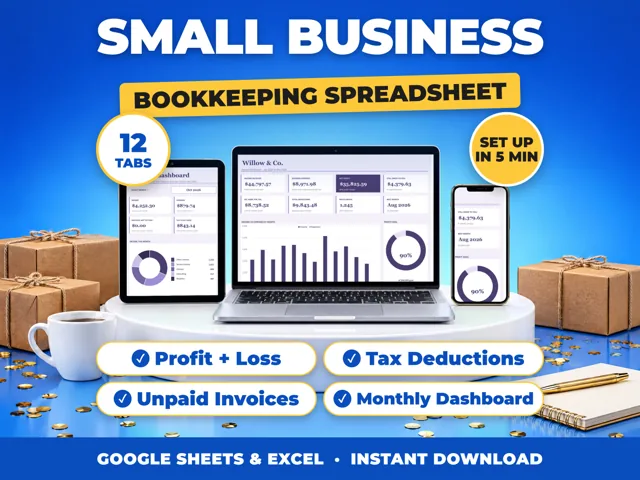
Record the expense in your business books like any other, with the date, payee, amount and category, keep the receipt, and note that you paid it personally. Then either reimburse yourself from the business account with a recorded transfer, or record it as an owner contribution. IRS Publication 583 (December 2024) says to keep business and personal accounts separate. A ProfitDrawer bookkeeping spreadsheet logs these costs on its Expenses tab with a receipt link.
Steps:
- Keep proof. Save the receipt and the card or bank statement line that shows you paid it.
- Enter it in the business books in the right category, for example Supplies or Software, and add a note such as "paid from personal card."
- Settle it one of two ways:
- Reimburse yourself: move the exact amount from the business account to your personal account and note which expenses it covers.
- Owner contribution: leave it unpaid back and record it as money you put into the business.
- Do it monthly, not at year end, so nothing is forgotten.
What matters for a deduction is that the cost is ordinary and necessary for your business, as Publication 334 (2025) explains, and that you can prove it. For a mixed purchase, such as a phone used for both, only the business part counts.
Avoid recording the reimbursement transfer as a second expense, or the cost is counted twice. If this happens often, a separate business card makes the records simpler. General information, not tax advice.
Source: IRS Publication 583: Starting a Business and Keeping Records · Updated
Tools and spreadsheets for this

Related questions
- How do I separate personal and business expenses when I use one card?
- Do I need a separate bank account for my small business?
- Do I need to keep paper receipts or are photos enough?
- How do I keep track of business expenses as a small business owner?
- What business expenses are tax deductible?
- How do I keep track of business expenses in a spreadsheet?
All questions on ProfitDrawer Answers →
General information, not tax, legal or financial advice. Check the rules for your state and your situation.