
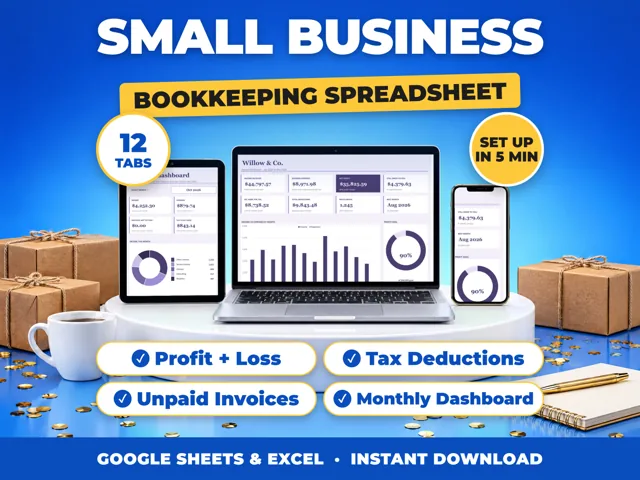
Go through the card statement every week, mark each charge as business or personal, record only the business charges as expenses, and keep a receipt or note showing the business reason for each. IRS Publication 583 (December 2024) says to keep business and personal accounts separate, and the personal part of a mixed expense is not deductible. ProfitDrawer's bookkeeping spreadsheet has a Business? Yes or No setting per category that keeps personal spending out of profit and tax.
A routine that works with one card:
- Download the statement each week or month.
- Mark every line B (business) or P (personal). Do it while you still remember what each charge was.
- Record the business lines with date, payee, category and amount, and save the receipt.
- Split mixed items. If a phone plan is 60% business use, record 60% of the bill as the expense. The personal 40% is not deductible.
- Ignore or tag the personal lines. In a ProfitDrawer workbook, use a category set to Business? No, such as Personal, so it never reaches profit or tax.
If you pay a business cost with a personal card, record it as a business expense and note "paid personally". If the business card pays a personal bill, record it as an owner draw, not an expense.
The long-term fix is a separate business account and card, which turns your statement into a first draft of your books.
General information, not tax advice.
Source: IRS Publication 583: Starting a Business and Keeping Records · Updated
Tools and spreadsheets for this



Related questions
- Do I need a separate bank account for my small business?
- How do I keep track of business expenses as a small business owner?
- What business expenses are tax deductible?
- How do I pay myself from my small business?
- What are the main categories of business expenses?
- How do I keep track of business expenses in a spreadsheet?
All questions on ProfitDrawer Answers →
General information, not tax, legal or financial advice. Check the rules for your state and your situation.