
To start a window cleaning business, choose homes, storefronts or both, check the business license rules in your city, county and state, buy a basic tool kit, safe ladders and insurance, and set prices per window or per job that cover your time and travel. Then find customers in a few nearby neighborhoods and sign them up for repeat visits. Startup costs are low because the core tools are simple. What makes it work long term is safe ladder habits, fair pricing and a steady route of repeat clients.
This guide walks you through each step, with an example budget, a worked pricing example and a 30-day launch plan.
1. Choose the window cleaning work you will offer
Pick a starting market. Each one has a different rhythm:
- Residential: one and two-story homes, inside and out. Higher price per visit, usually every three to six months.
- Storefront routes: shops, cafes and offices at street level, often cleaned weekly or monthly. Lower price per visit, but steady and quick.
- Add-on services: screens, tracks, sills, skylights, mirrors and glass doors. Easy extra income on each visit.
- Post-construction and move out: removing paint, stickers and dust from new or empty homes. Slower work, priced higher.
Many beginners mix homes and a storefront route. The route gives steady weekly income, and homes give bigger tickets. Avoid high-rise and rope work; it needs special training and equipment.
2. Check local requirements and register
Rules change from place to place, so check with your city, county and state before you take paid work. The SBA explains that most businesses need some mix of licenses and permits, and that the details depend on your activity and location.
A simple checklist:
- Pick a business structure. Most window cleaners start as a sole proprietor. Some form an LLC to separate business and personal liability; a state filing fee applies.
- Register your business name. If you trade under a name other than your own, most states require a DBA ("doing business as") registration.
- Get a general business license from your city or county if they require one.
- Get an EIN from the IRS if you will hire employees or form a partnership or corporation. It is free on irs.gov, so never pay a website for one.
- Get insurance. General liability insurance is the usual starting point, since a broken window or a ladder scuff can happen. Storefront clients often ask for proof of insurance. If you hire help, workers' compensation rules apply in most states.
Ladder safety comes first. Falls are the main danger in this trade. Inspect every ladder before use, set it on firm, level ground, keep three points of contact, and never work near power lines. A ladder stabilizer protects gutters and adds grip. If a window is higher than your gear or training allows, say no or use a water-fed pole from the ground.
3. Work out your startup costs
List every cost before you buy. The SBA suggests separating one-time costs, such as tools and licenses, from monthly costs, such as insurance, phone and fuel.
Example budget, your costs will differ:
| Item | Low | High |
|---|---|---|
| Squeegees, channels, scrubbers, buckets, tool belt, towels | $100 | $350 |
| Ladders and ladder stabilizer | $150 | $600 |
| Water-fed pole system | $0 | $2,000 |
| Business registration and local license | $50 | $500 |
| General liability insurance (first months) | $100 | $800 |
| Simple website or booking page, business cards | $0 | $400 |
| Marketing (door hangers, flyers, local ads) | $50 | $500 |
| Phone and software for the first months | $50 | $150 |
| Total | $500 | $5,300 |
Plug your own numbers into the free startup cost calculator to see your total and how long your savings will last.
4. Set your prices
Window cleaners usually price per window (often called per pane), per job based on home size, or a flat monthly rate for storefronts. Per-window pricing is easy to explain, while a flat job price is simple for the customer. Start from your costs either way.
Worked pricing example (example numbers only):
- Job: a two-story home with 24 windows, inside and out
- Time: 3 hours
- Your target pay: $35 an hour, so 3 x $35 = $105
- Supplies used: $4
- Driving: 14 miles round trip. Using $0.70 a mile as a rough running cost, 14 x $0.70 = $9.80
- Share of insurance, phone and marketing: about $10 per job
- Cost before profit: $105 + $4 + $9.80 + $10 = $128.80
- Add a 20% markup for taxes and slow weeks: $128.80 x 1.20 = $154.56
- Round to a job price of $155
- Per window: $155 divided by 24 windows = about $6.46, so a per-window rate of $6.50 gives $156 (24 x $6.50)
Price screens, tracks and hard water stain removal as add-ons. The free price per job calculator does this math for you. Look at what local window cleaners advertise so your prices sit in a sensible range, then compete on being on time and leaving no streaks.
5. Get your first customers
Window cleaning grows best in tight areas, so you spend more time cleaning and less time driving.
- Start with people you know. Clean for friends and family, take before and after photos and ask for referrals.
- Door hangers on streets near your first jobs. Neighbors notice clean windows.
- Walk into storefronts with a simple offer and a monthly price. Many small shops never get asked.
- A free business profile on map and search listings, with photos and your service area.
- Offer a recurring schedule. Book the next visit before you leave each home.
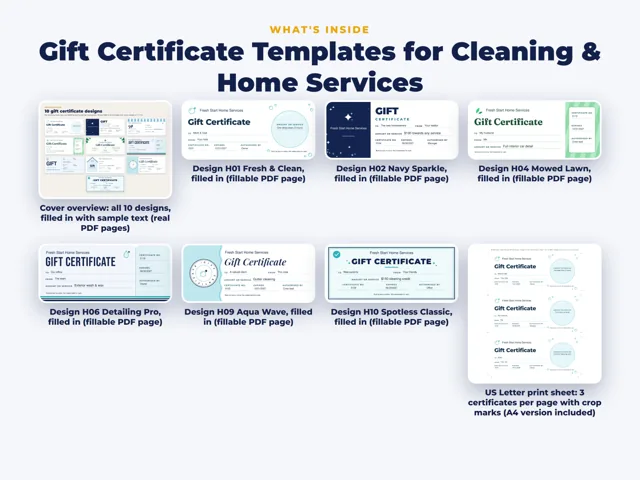
- Gift certificates for holidays and Mother's Day bring in new customers through your current ones. The home services gift certificate templates include 10 designs as fillable PDFs, print sheets and editable slides.
Our guide on how to start a cleaning business has more ideas if you plan to add house cleaning later.
6. Track your money and plan for taxes
Keep business money apart from personal money from the first job. A separate checking account makes tax time far easier.
Track these every week:
- Income from each customer, and which invoices are still unpaid
- Expenses such as tools, supplies, insurance, phone and advertising
- Mileage for driving between jobs and to buy supplies. The IRS business standard mileage rate for 2026 was 72.5 cents a mile from January to June and 76 cents a mile from July to December. Check the 2027 rate on irs.gov before you file.
As a self-employed window cleaner you pay self-employment tax of 15.3% (12.4% Social Security plus 2.9% Medicare) once your net earnings reach $400, on top of income tax. If you expect to owe $1,000 or more for the year, the IRS says you generally need to make estimated tax payments. See our guide to small business tax deadlines for 2027 and the free self-employed tax calculator. This is general information, not tax or legal advice.
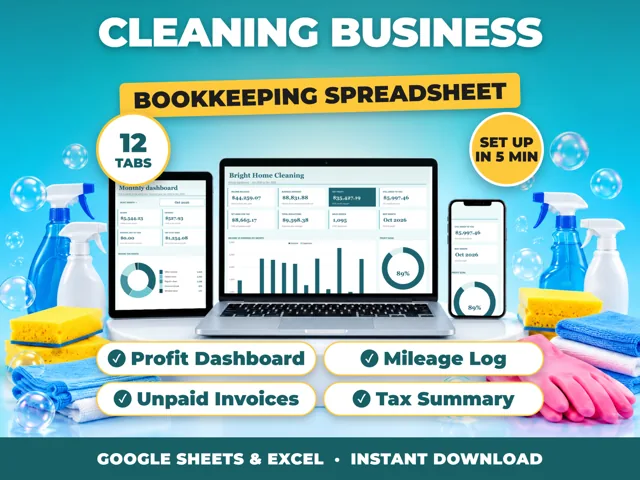
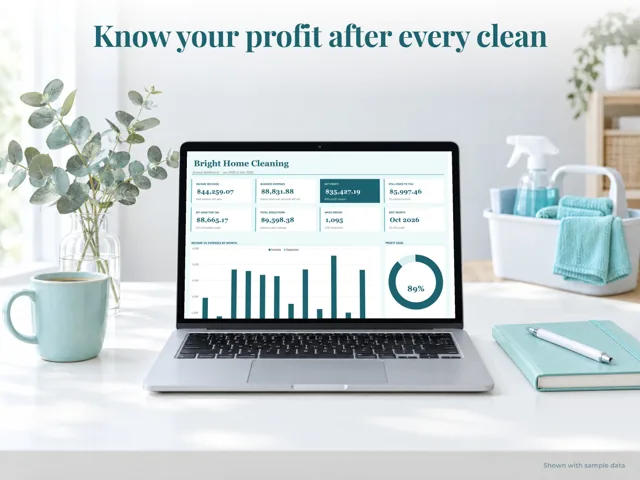
A spreadsheet is enough at the start. The cleaning business bookkeeping spreadsheet works well for window cleaning too. It has a START HERE tab, Settings, dashboards, Income, Expenses, Mileage, Unpaid Invoices, Top Clients, a Monthly Summary, Quarterly totals and a Tax Summary, in Excel and Google Sheets.
7. A simple 30-day launch plan
Days 1 to 7: decide and register - Choose homes, storefronts or both, and pick two or three neighborhoods. - Check licenses with your city, county and state. Register your name if needed. - Get insurance quotes and open a separate bank account.
Days 8 to 14: set up - Buy your tool kit and ladders. Practice on your own windows until you leave no streaks. - Time yourself per window so your prices use real minutes. - Write your price list, including add-ons. - Set up your bookkeeping spreadsheet and a mileage log.
Days 15 to 21: tell people - Message 20 people you know and ask for referrals. - Hand out door hangers and visit ten storefronts. - Set up a free business listing with photos.
Days 22 to 30: clean, learn and adjust - Do your first paid jobs and record real times. - Book each customer's next visit before you leave. - Ask for reviews and photos. - At month end, check income, expenses and profit.
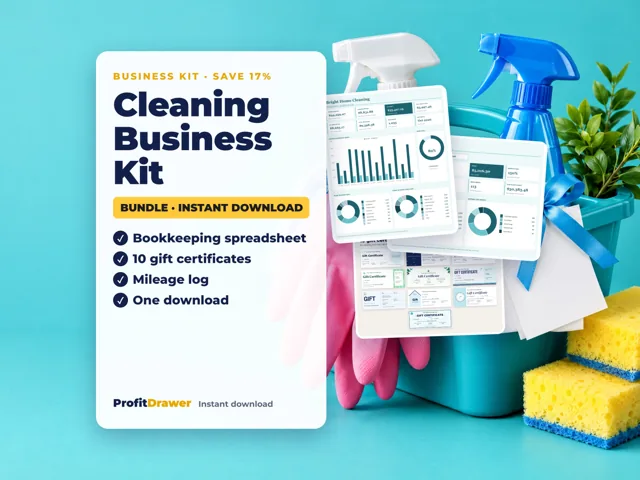
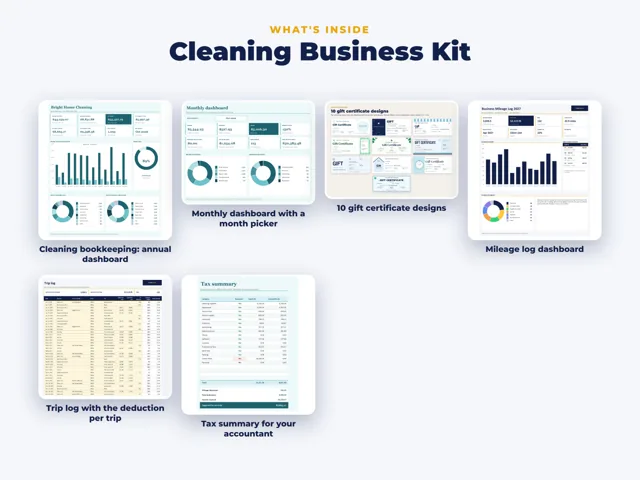
If you want everything in one download, the cleaning business kit bundles the bookkeeping spreadsheet with 10 gift certificate designs and a mileage log.
Common mistakes to avoid
- Taking risks on ladders. No job is worth a fall.
- Spreading out too far. Drive time eats your hourly pay.
- Not booking repeat visits. Recurring customers are the core of this business.
- Pricing only to be the cheapest. Reliable, streak-free work keeps clients.
- Not saving for taxes. Put a share of every payment aside.
Window cleaning is one of the cheapest service businesses to start. Work safely, price on real numbers, build a tight route and keep clean records, and you will know exactly how your business is doing.
Tools for this
 Startup cost calculatorTotal startup cost, monthly costs and months of runway.
 Price per job calculatorA price that pays you, covers overhead and leaves a profit.
 Self-employed tax set-aside calculatorHow much of your profit to set aside for taxes.
Cleaning Business Bookkeeping Spreadsheet
 Save 18%
Cleaning Business Kit

Gift Certificate Templates for Cleaning & Home Services
Questions people ask
What do you need to start a window cleaning business?
You need squeegees and channels, scrubbers, buckets, a tool belt, towels, safe ladders, a vehicle that fits them, any business license your area requires and general liability insurance. Add a simple price list and a way to track income, expenses and miles. A water-fed pole system is useful for higher windows but is not required on day one.
How much does it cost to start a window cleaning business?
A solo cleaner working on one and two-story homes can often start for a few hundred dollars plus insurance and a local license. Our example budget below runs from about $500 to $5,300, where the high end includes a water-fed pole system. Your costs will differ, so add up your own list in the free startup cost calculator.
How do I start a window cleaning business with no customers?
Start in one or two neighborhoods close to home. Clean windows for people you know, take before and after photos, leave door hangers on nearby streets and set up a free business listing. Offer a regular schedule, such as every three or six months, so each new customer can become repeat work.
How do I start my own window cleaning business safely?
Treat ladders as the biggest risk in the job. Inspect them before each use, set them on firm, level ground, keep three points of contact and never work near power lines. Turn down jobs that are higher than your gear and training allow.
Do I need a license to start a window cleaning business?
Most places want at least a general business license, and rules differ by city, county and state. Check with each before your first paid job. The SBA page on licenses and permits explains which level of government handles what.
Sources
- Launch your business: Apply for licenses and permits (U.S. Small Business Administration)
- Launch your business: Register your business (U.S. Small Business Administration)
- Plan your business: Calculate your startup costs (U.S. Small Business Administration)
- Get an employer identification number (IRS)
- Self-employment tax (Social Security and Medicare taxes) (IRS)
- Estimated taxes (IRS)
- Standard mileage rates (IRS)
General information, not tax, legal or financial advice. Check the rules for your state and your situation.