
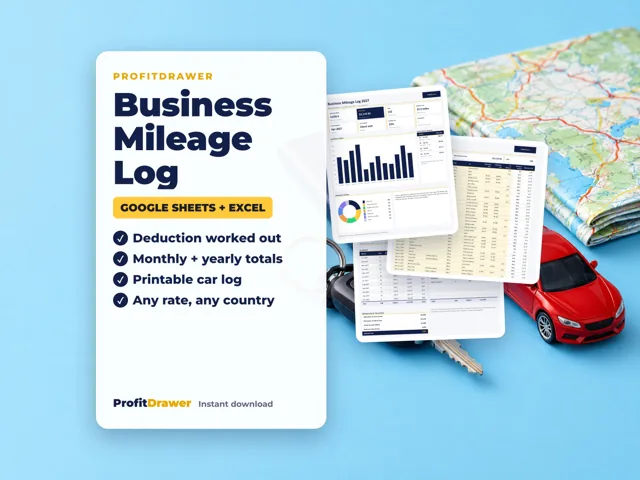
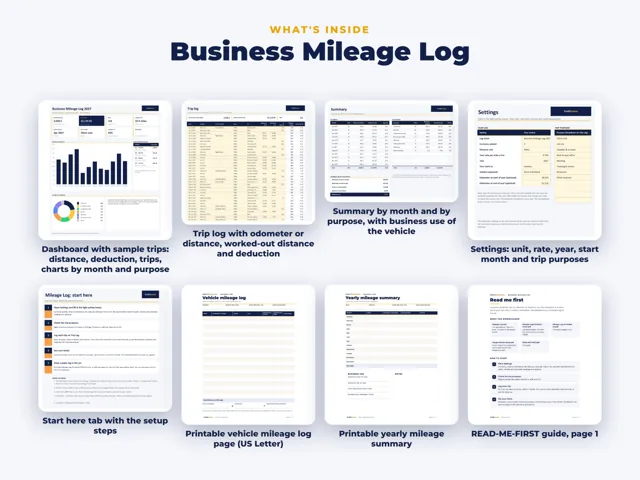
For each business trip, record the date, destination, business purpose and miles, at or near the time you drive, plus your total miles for the year and the date you started using the vehicle for business. IRS Publication 463 says a written record is generally needed, and a weekly log can count as timely. ProfitDrawer's mileage log works out the deduction at your own rate; the 2026 IRS rate is 72.5 cents a mile to June 30 and 76 cents from July 1.
A mileage log the IRS would recognize has, for every trip:
| Date | From / to | Business purpose | Start odometer | End odometer | Miles |
|---|---|---|---|---|---|
Also keep:
- Total miles for the year, business and personal, so you can show the business share.
- The date you started using the car for business.
- Receipts for parking and tolls paid on business trips.
- Fuel, repair and insurance receipts if you use actual expenses instead of the standard rate.
Example: 2,000 business miles before July 2026 and 2,200 after give 2,000 x $0.725 + 2,200 x $0.76 = $3,122.00. Keep the log at least 3 years from filing the return that claims the deduction, and longer for actual-expense depreciation, since records cover each year of the recovery period. Logs rebuilt months later from memory are hard to defend.
General information, not tax advice.
Source: IRS Publication 463, Travel, Gift, and Car Expenses · Updated
Tools and spreadsheets for this


Related questions
- What is the IRS standard mileage rate for business in 2026?
- Can I write off my car as a business expense?
- How long should a small business keep tax records and receipts?
- How do I keep track of business expenses as a small business owner?
- What business expenses are tax deductible?
- How do I keep track of business expenses in a spreadsheet?
All questions on ProfitDrawer Answers →
General information, not tax, legal or financial advice. Check the rules for your state and your situation.